Loosely Rigorous
I was waiting for a friend of mine to meet me for a drink one evening last March at the bar Babette on Karl Marx Alle in Berlin. Its situated in this very kind piece of showpiece DDR modernism, a 60’s glass box of a pavilion built in front of some of Berlin’s slabbiest slabs. If we ever publish a tour guide to Berlin this will be the place we recommend for a relaxing, pricey drink after a day of trudging through the wind and rain looking at communist housing projects.
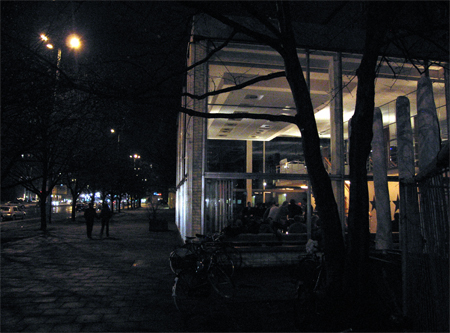
I don’t really know what this was built for; one would guess a showroom of some kind but a showroom is what you sell things in and that wasn’t a process of daily life that was celebrated behind the iron curtain in the way that this thing was celebrating whatever was supposed to be going on inside of it. Whatever it was, it was definitely an activity that was on show for all to see, the entire envelope of the thing being sheathed in plate glass. A true celebration of something. It is Modernist, idealized, Functionalist space, the kind we love around here, because in the end the function probably didn’t really matter that much to those DDR Baumeisters, anyway. Though some historians and theory wonks might disagree with this point, and we kindly invite them to school me if they do. Because this is (supposed to be) a blog.
Yeah, so I’m sitting there waiting for this dude to show, sipping a glass of overpriced red wine. Gazing at the cars slipping by in the rain, feeling decadent. I glance upward at the ceiling and this blatant flaw in the jewel box’s construction slapped my trained eyes of an architect in the face.
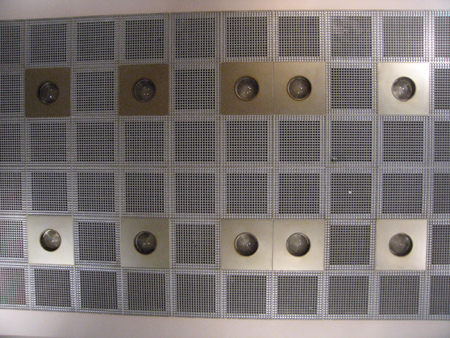
Seeing this really makes me realize what hell people like Mies van der Rohe and his disciples had to go through to really get that high Modernist architecture to be tight. I mean, what their construction contractors had to go through. Its the kind of nonsense that one never would find in a similar situation in West German constructions, never ever I don’t think. But in America, yeah, probably somewhere, but not like on the big boulevard in Washington DC where the soldiers would parade by in front of ICBMs towed along on tractor trailors.
That said, seeing something like this feels like a lilting sigh of relief, a gentle pause from the persistent rigor that glues 60’s Modernism together.