Activism / Architects / Damage fetishism

Destructing Value in Vall d’Hebron

Tue 13th Dec ’11

Last week I took a cheap flight down to Barcelona and visited an old friend there. I arrived in an overtired and generally run down state; I’d only slept three hours the night before and had woken up from an inflight nap with the beginnings of the cold that’s been going around. My body was additionally confused by the drastic shift in climate, by the mild air and the glare coming off the sun-drenched C-31 highway leading into town. It felt to me like a trip to California, but with a splash of airport cologne having been substituted for disinfectant air freshener.

I was only really there to spend time with Ankur and his family, and beyond that didn’t really have a plan. On the second day, the two of us followed the lead of his four year old son, who for obvious reasons wanted to take a tour of the city on an open-top bus. Finding the stop proved difficult. As we shlepped it a half a mile or so to the next one, I was taken by the sight of this mirrored glass office building:
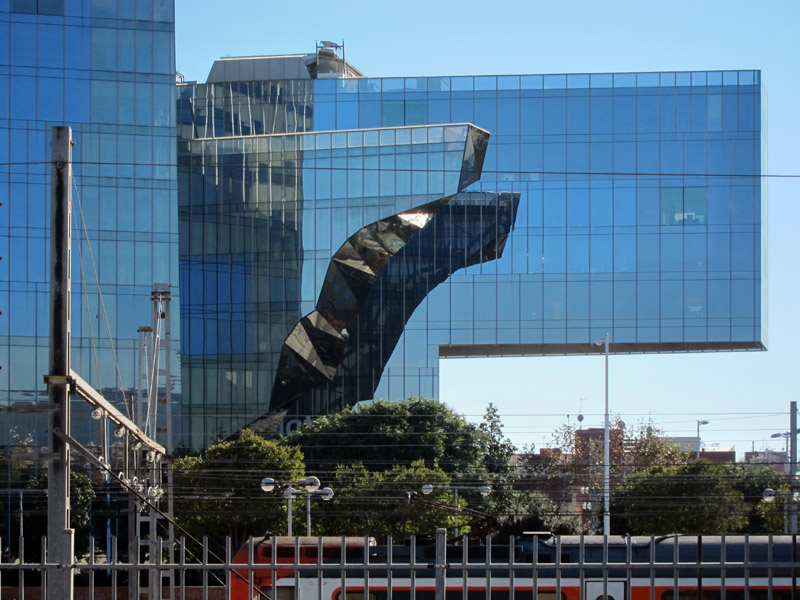
The image speaks for itself, especially to covert fans of glassy corporate architecture like me. I suppose it was the craggy tessellated underside of the one chunk sandwiched between two others, and its reflection, that really turned me on.

That evening I learned more about the building using the Google search website. I found out that it was the Gas Natural tower, the last built work of Enric Miralles, actually completed by his partner and wife Benedetta Tagliabue some five years after his premature death from a brain tumor in 2000. Although I’ve forgotten about a lot of the work that I used to look at while studying architecture in the ’90s, reading that name immediately coaxed distant memories of a certain issue of El Croquis that had really turned me on. From that moment I knew what my plan would be for the next sinus-congested days.

Ankur, Claudia and their son Vivek seemed totally fine with my idea to hunt down ’90s architecture, and the next day we drove their Seat minivan out to the work that was way way at the top of my list. But what I found in the Vall d’Hebron was a total buzz kill. Miralles and Pinós’s Archery Range for the 1992 Barcelona Olympics was there, but not in the state I’d thought I would find it in. I suppose I could have managed my expectations much better if I’d first stumbled upon this blog entry from 2006.
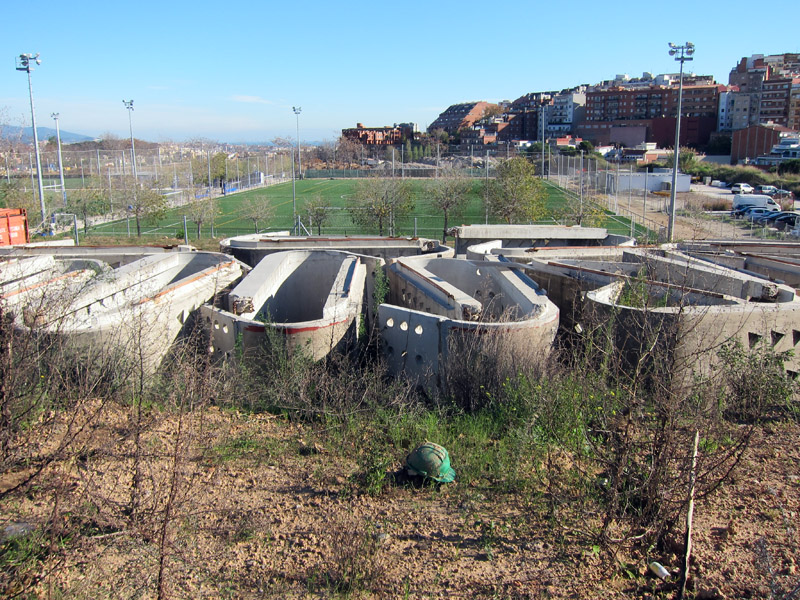
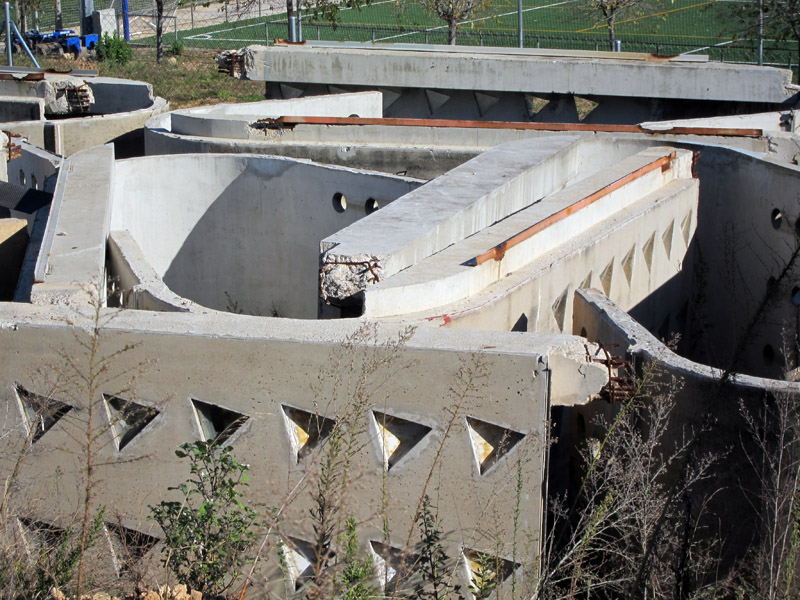
These neatly arranged concrete elements are all that I saw of the former archery range, though I later discovered that the roof structure dug into the hill is still there a couple hundred yards away (see the link above). I think I was too fazed, too disbelieving, to have gone any further with this particular chapter of our treasure hunt. A billboard from the construction company carrying out the park renovations, still in progress, read: “Construïm Valor”, meaning “Constructing Value” in the Catalan. Pfff… the motto made me wince, especially when I thought about all the vacant real estate that companies like this had speculatively built down by the water in the last decade or so.
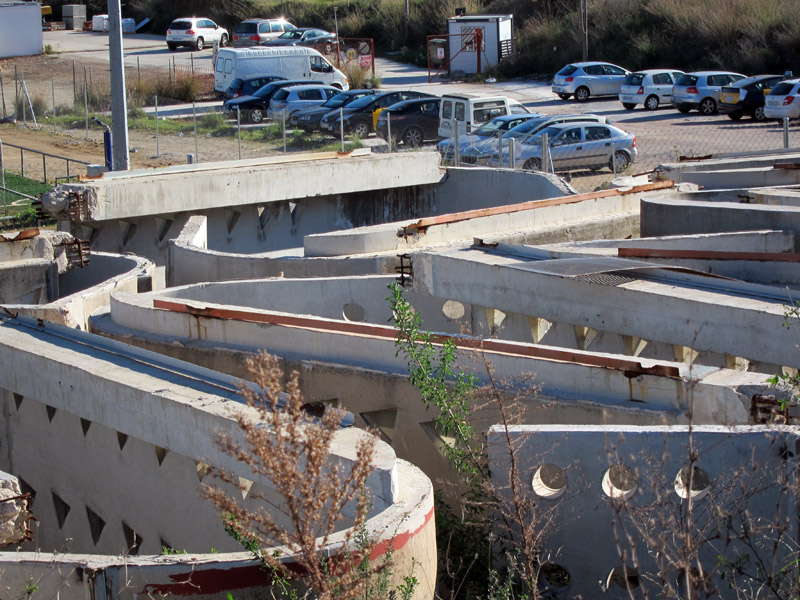
At least I knew I had a good scoop for Slab, but the consolation was a weak one. Despondent, I felt that there had to be something more to be done. To put it in the clearest terms, I felt like I simply had to see this work with my own eyes, some how.

The next day I went and checked out Mies van der Rohe’s famous pavilion for the 1930 Barcelona Expo, and it was there that an idea came to me. Perhaps it was the peace and clarity of that architecture, so different from Miralles and Pinós’s exhuberant techno-organicism. The atmosphere helped, but it was really the quite literal facts on the ground that said something to me; the fact that this pavilion wasn’t the one that Mies has built – that edifice had been dismantled along with the rest of the expo in 1930. The Mies pavilion the we all know and love, so totally useless, is in truth a reproduction, completed in 1986 by a group of high profile architects and archi-fanatics.

So that’s my idea now, to do the same thing with the old archery range. Be a part of it. Sign

here !

Pulling this off will make last year’s successful coup with Hejduk’s tower look like a walk in the park. But it’s our only chance. Like Miralles’s architecture, this dream is erratic, maybe even absurd, but still makes sense.


6 Responses to “Destructing Value in Vall d’Hebron”

  1. ie casanovas writes:

    The pavilion was torn down when the Vall d’Hebron L5 metro station was built, maybe 2 years ago or so, because somehow they had to dig a well just there or something like that. I kind of believe the engineers, though, because the pavilions are built on a former landfill site and probably it’s not a good idea to do too much stuff underground (Miralles said, I think in the same Croquis issue you mention, that the foundations went 15 metres deep…)

    Anyway, the buildings ARE supposed to be rebuilt, directed by Carme Pinós (Miralles’ former partner). But I remember her saying in some interview or whatever that there is less money available for the rebuilt pavilion than for the original pavilion, and that she isn’t too optimistic. Since the city council has gone even more conservative and bourgeoise morals have succesfully appropriated crisis and turned it into the return of “daddy’s economy”, I’m not sure anything is gonna happen. You could try contacting Carme Pinós, though.

    Most of Miralles’ early buildings with Pinós are in a sorry state, though. Most of them are public buildings and the town councils don’t know what to make of them at all. The thing is they took advantage of this moment when parliaments were something new in post-Francoist Spain and town councils didn’t yet quite know what they wanted. But when they realised that Miralles had built something corresponding to a democratic city they went into panic – the foremost examples are the building in Hostalets, which was to be a building for sports but the town council installed their offices there since it cost them so much money, and the project for a street in Reus where the local storeowners got very angry and told the city to tear the whole street down after it was completely built (which they did, and nowadays only some streetlamps remain.) He never had this problem again because he kind of sold out with Benedetta… although it’s still Miralles, after all.

    I recommend you http://www.google.com/url?sa=t&rct=j&q=&esrc=s&source=web&cd=2&ved=0CCYQFjAB&url=http%3A%2F%2Fbooks.google.com%2Fbooks%2Fabout%2FEnric_Miralles_a_izquierda_y_derecha_tam.html%3Fid%3DFR7tSAAACAAJ&ei=bGDsTqGHO8WwhAeIxvywCA&usg=AFQjCNGmcYNLo7IqogOQsvWHrt5jEouS-w this book on the current state of Miralles and Pinós’ early (and best) stuff.

  2. Divider
  3. ie casanovas writes:

    ps. take a look at the structural logic of Miralles’ buildings. It’s always quite machine-like and rationalistic – if we take out the idea that “reason” in architecture means simple and cheap. Maybe “erratic” is a nice way of describing his stuff but somehow I think everyone always misses how, after setting the initial hypotheses, he actually looked at construction first and foremost and this is how his projects evolved… I think people don’t accept that this too can be erratic, and if for them “construction” means something else then it’s because they’re just lazy.

  4. Divider
  5. ie casanovas writes:

    (I have to say, though, that Miralles himself might have liked to see the prefabs from the archery range turned into this bowel labyrinth they’re now… isn’t it awesome that the same pieces are part of a radically different situation? maybe a true Mirallesque solution would be, like he did after the collapse of the basket stadium in Huesca, to turn the bowel labyrinth into a new project)

  6. Divider
  7. O.M. writes:

    @ie casanovas,

    Thanks a ton for the further information, it’s great to know that the state of this project hasn’t gone completely unnoticed. To tell you the truth I set up the petition without any expectation that something could ever come out of it, it was just a gesture to express the absurdity of the whole situation with how our society values and devalues cultural artifacts. Something seems needs to be indoctrinated within a mainstream (e.g. bourgeois) cultural consciousness or its doomed to be disposed of, whether by the flimsiness of its materials and construction or the ease with which it can be disposed of and replaced. But yeah, it also struck me that Miralles himself would have actually found the rearrangement of the precast pieces to be fitting, it seems to be totally in keeping with the underlying spirit of his work, or of the early work at least. But somehow the thought didn’t quite make it into the stream of the text, it’s great that you picked the subject up, though!

    That book you linked to is a must read for me for sure. Due to Miralles’s fascination with the ephemeral his work is the perfect material to use for such a study.

    I do know what you mean about the rational side to Miralles’s work, and to its structural design in particular. It was that quality that I think inspired be so much when I first saw images of it as a student. The work seems to be intensely thought through as a material structure, and that’s something really different from all the computer generated stuff that followed in the next generation of radical formalism. Though to call this work formalist is to flatten it. To me its really clear that the architecture was turned over again and again intellectually, and that the designers had a very disciplined understanding of statics. Some of the later stuff, though, doesn’t really deserve the same praise, I think.

    Anyway, thanks for the wonderful reflections, its great to know someone down there has an inkling of what the hell is going on down there. It was my first time in Barcelona and I have to say I had a very uncanny experience of the stuff that was built there in the last 20 or so years. Strange to see all the vacant new-build commercial space, no matter how much I’d been prepared by all the news of the burst real-estate bubble. It all seems so flimsy, like the chunk of purple foam I saw broken off a corner of the Herzog & DeMeuron job, for example. Also the infrastructure built for the olympics seems to be kind of showing its age -peeling, crumbling, warping and rusting, depending on what it was made from. The stuff is too young for anyone to give a shit about and too old to express the fresh vision of the city that engendered it. Even FOA’s park seems kind of screwed, and that’s only 8 years old or something. A strange town, north of Poble Nou especially.

  8. Divider
  9. O.M. writes:

    Just realized that that photos of the archery range that I linked to are by a guy I studied architecture way back when…nice work Dieter!

  10. Divider
  11. Dieter writes:

    It’s quite a surprise to see these dismantled and a shame for their loss. When I saw this project in the mid-90s it was being used for a school track event. What was so compelling about this and the Igualada Cemetery too was the combination of spaces organised with these immaculate precast components used like a clever mason would lay up brick. The resultant spaces being very much a part of their landscape, the materials and how they were being handled spoke to a mastery in construction but also such dexterity in Architecture. That’s not a quality that was all that prevalent in the 90s – those experiments often seemed to miss that vital part.
    I hope these get rebuilt or reused with the same thoughtfulness.

  12. Divider

Comment