Crisis | Eurotrash | Hyperreal

Dig me up, Scottie

D.S. / Mon 5th Sep ’11

black monolith 2

Sorry, I can’t hear you, in my Motel-One turquoise “viel Geld für wenig Design” (plenty-design-for-little-money) Arne Jacobsen Egg chair, I’ve got a Caterpillar in my ear. How can this man slouched on the modernist sofa in the hotel’s loggia be so calm among the construction mess that surrounds him?

egg chair man

smart phone guy

I guess because he’s really not here. He’s cyborged himself into his smart phone and has found placid serenity somewhere else cyber. Something distant has temporarily gotten hold of his brain through his eye sockets. Maybe he’s near the nadir of a tanked investment that has just crashed through the 50 day moving average, or in a candle stick graph of his short sell that’s just brushed a Bollinger band, and he’s already booking a room at the Mandala, or he’s checking Zalando for the latest model of Geox shoes he has a knack for? Who knows? But he certainly doesn’t seem to be here.

These are some really interesting thoughts. I appreciate the opportunity of having them every day. Commutes in Berlin change almost daily depending on the circulation requirements of the many construction sites that dot one’s way to work. The last few months things have really crescendoed to new levels on my commute, around the future junction of Leipziger Straße and Axel-Springer-Straße that is nearing completion. This connection was severed by the Wall. Soon, it will direct four lane traffic right past my studio window towards the A111. The adjacent Motel One was finished earlier this high season, touting viel Design für wenig Geld (plenty design for little money) to Berlin’s many visitors. “But why in German?”, I ask “who speaks German that stays here?” and now I feel this has got to be deliberate, this taunting on my way to work, reminding me of all the design I offer for little money.

vdfwg

As the finishing touches are put to the new intersection, I get shepherded around Motel One in constantly changing ways. I am led through makeshift channels of galvanized steel mesh that cut fresh twists and turns through heaps of rubble and virgin construction sands like CNC tool paths. Different facets of Motel One’s rich value designs reveal themselves to me every day, brushing up against different factory fresh surfaces, pieces of furniture, or topiaries. I come comically close to people in designer furniture, closer than ever intended, spot new superimpositions of myriad reflections, or almost run into an old lady and dog or get hit by a cyclist on the loggia, lost for a passage around Motel One. It feels like universes colliding on a smaller, more mundane scale. Pedestrians seem like machines whose algorithms cannot cope with a new, unexpected topography. With each new choreography and disparate encounters, each new vista, Motel One seems to acquire some mysterious dimension. Did I just spot Yul Brynner, are those cables sticking out of this man’s chest?

way round m1

no way thru

building intro

eternal shade

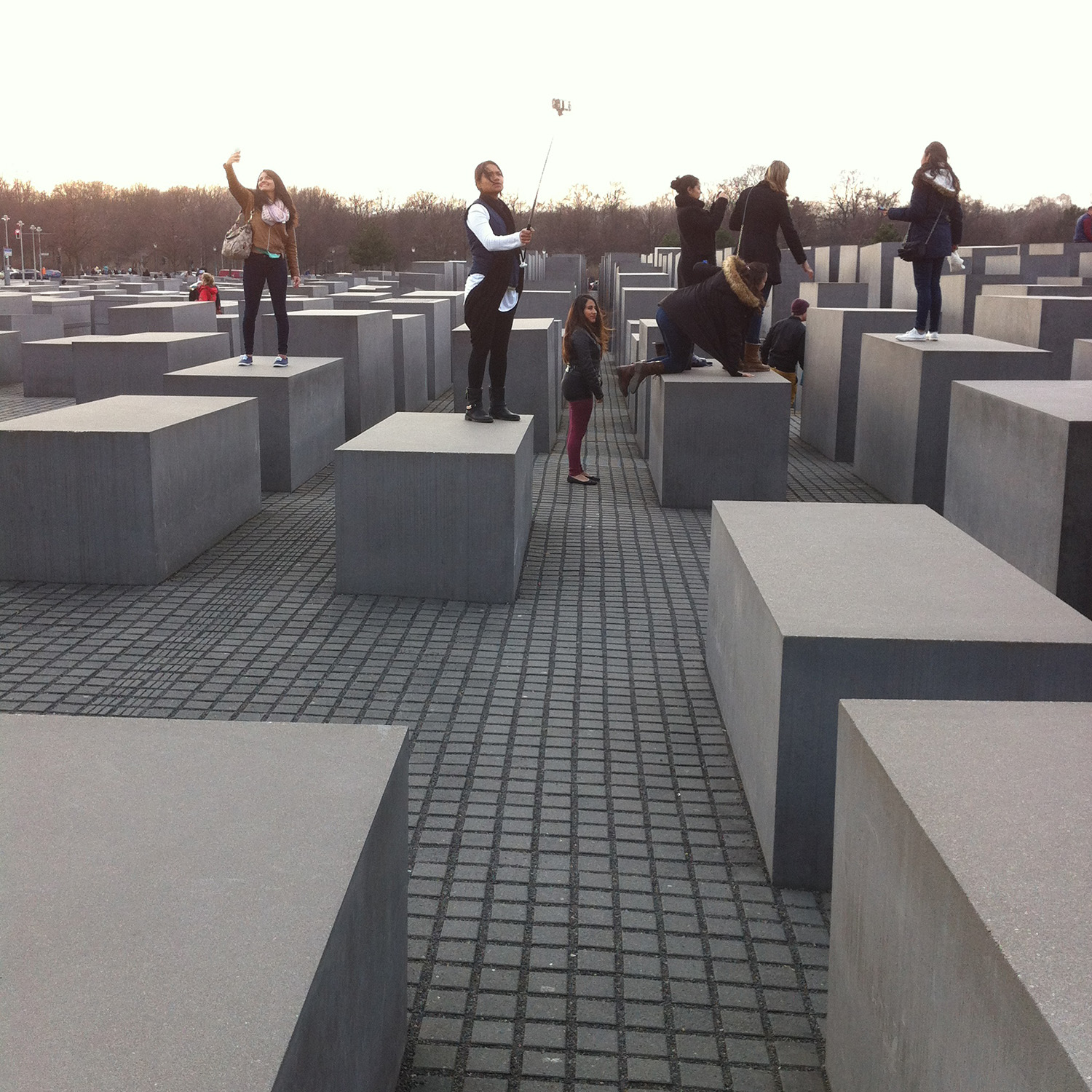
The courtyard reminds me of New York, somehow. Below, there’s a green amenity space of manicured lawns and wood chip covered terraces. Beach recliners in Motel One turquoise and brown look forlorn amidst all the construction paraphernalia and soaring GDR era high rises, look like creatures themselves. Occasional guests in slacks and other business casual slurp Cosmos or wash down Alfons Schuhbeck sandwiches with a wheat beer, on timber decking stained in mahogany. Brand is everywhere. Retracted linen parasols carry a promise of intense sunlight; an empty promise, given the eternal shadow cast by the adjacent GDR high rise. Unless there is foreboding in these parasols? The whole thing feels like it came out of nowhere, plopped down and teleported from a parallel reality, where it left a gaping absence, as alien as the presence it has created, here, and tearing some people out of context along with it. Through kaleidoscopic glass, I see projections of films that show this place in the twenties and thirties, topical mementos excavated by all this digging. On one of my daily recurrences around Motel One, it feels as if it has solidified or cured into a monolith of pure carbon. I suddenly think of the Ka’ba and Mecca, of tourism and pilgrimage and meditative recurrence, the infinite verticality of meteorites and of sacred spaces that can only be attained in mind and not in body, and all the things sinister and divine that happen behind the dark, silent reflections on its Low-E glass.

black monolith

Place Making | Spiritual | Urban Environment

Squeezing in Some Spirituality (5): Evangelische Segenskirche / Stadtkloster Segen – Communität Don Camillo

O.M. / Sat 27th Aug ’11

For the latest in Victor Brigola’s series photographing Berlin’s infill churches, it would be trite to talk about how nice buildings can look when covered with scaffolding and tarpaulins. That’s true, but such an observation would merely point out the obvious, and will therefore be refrained from.

In a sense, the presence of such a covering simply heightens the rather abstract structural qualities that these churches all seem to have. None of them are as elaborate in their detailing or as dense in their rendering as the models from which they were derived, in spite of the fact that their façades are generally coated in a rife-running admixture of decorative treatments. And in this case, as the church + cloister stood before the photographer on a chilly morning last spring, the most juicy parts of all have been both muffled and abstracted. Beneath the white sheathing can be found the rich combination of a loggia, crenellated turrets, a circular white clock face and a broad, gothic-arched drive that leads to an inner courtyard which is has been touted as a verdant Shangri-La, far removed from the city’s bustling streets -in essence, a real hodge podge of turn-of-the-19th-century eclecticism. The architect, whoever he was, truly red-lined his understanding of historical styles, having shifted his encyclopaedic knowledge of them into a proverbial overdrive, if you will, which was his reward, perhaps, for having finished top of the class at some stiflingly oppressive Wilhelminian Bauakademie.

Buildings | Ornament | Public Space | Signage

Pet Insurance

A.D. / Thu 25th Aug ’11

GSW petSelling currywurst can be a transient act, a nowhere, or anywhere event. In Berlin, a wurst might even walk to you. Yet Coffee&Curry, at the base of Sauerbruch Hutton’s GSW building, has loyally anchored itself to the building’s feet, basks in the awe-by-association of the passer-by, flirts in the foreground corner of the postcard.

A pet relationship is essentially about belonging. Pets are also faithful derivatives. The signage on the imbiss is a recognizable graphic iteration of the GSW’s famed meat-pixeled rose-pixeled windows hovering above it. It is a tiny copy, a pocket version of a great novel, “paperback” architecture.

Structurally it is a prop, a simple decorated shed. And, as such, a billboard of sorts, albeit one that does not advertise currywurst. No loud drawings depicting smiling sausages attempting to eat their own kind, no giant 3-D wurst toothpicked onto the roof. While the GSW sells you insurance, this imbiss sells you the GSW. In place of mystery pork, it flogs architecture. This shack has staked out an optimal perspective for viewing the building, and invites you to look up, admire, and while you’re there, enjoy a currywurst. Maybe a coffee.

Pets say a lot about their owners. One can evaluate the merits of the building by investigating its tiny copy. And, standing there, I have to ask myself what makes the GSW so special. Special enough that a currywurst seller invokes it to sell sausages.

It is in fact a structurally gymnastic building. The original rectilinear tower from the 1950s not only still stands, but acts as a sort of stiffening spine for the wing-shaped addition. The wing is essentially tied back to the tower, and each junction between platform and wing and tower is beautifully, cleanly detailed. Shadows obediently follow built lines, the framing is delicate but not fragile.

The wing addition (right) is tied to the existing 1950s tower (left)

As with many SH buildings, a colourful facade smiles upon the city, and it is perhaps this gesture that Berliners, as well as the little imbiss, rarely see are drawn to. Within the complexities of built endeavors: contracts, codes, budgets, intricate air management systems, it is the procurement of a soft device: the fabric window shade that garners the GSW’s celebrity in Berlin. Amongst an infinite set of built parts, the window shades, in ca. 8-10 colors, become the building’s most obvious architectural gesture.

A passive heat gain strategy is responsible for the positioning of the massive glazed elevation, and this, as the building’s driving design principle, made it a winner with the clients, for sure.

But for the rest of us, it has more to do with its west-facing facade and the sun. Standing on Rudi-Dutschke-Strasse at Friedrichstrasse at various times of the day, you will encounter constant references to the cosmos. At noon, the facade is lit up in sunset oranges, reds and pinks, shades drawn against the sun, and later, in the evening light, shades open, the glazing reflects the real thing. Perhaps it is the quiet, intuitive performances of buildings that really communicate with us – on a frequency below glass domes, gurkens and pregnant oysters.

The first time I came across the imbiss was in March 2010, at which point it was blooming with GSW pride: red-orange pixel window ornament on 3 sides. It has since been “modernised”, namely in its reduction of colourful pixel-rectangles to one applied sticker on a newly painted cream metal box. Yet, in the end the little imbiss remains loyal to its owner, keeping the last panel, the last semblance of its pet relationship, on its west-facing facade.

Pet imbiss after modernising

Graffiti | Speculation | The Arts

Decline of the West-Berlin’s 80s art form

D.S. / Tue 23rd Aug ’11

Farbklangsystem, Spicherstraße

“If we look closely enough we shall have no difficulty in convincing ourselves that no one art of any greatness has ever been “reborn”.

“Every single art form, the Chinese landscape, Egyptian sculpture or the Gothic counterpoint, exists only once, never to return again in its soul and symbolism.”

Oswald Spengler – Decline of the West

framed atmo from past

Word! This art form is certainly staying put, left to steep in its own atmosphere of 80s transpirations. Well, most of it must have escaped through the array of vent holes on the left by now. Rarely has Spengler’s point been stressed as succinct and as well as with this redundantly framed description of an art work at Spichernstraße underground stop on Berlin’s U9 line, as if trying to heighten the distance in soul and symbolism one might already feel looking at the space invaders era art work by Gabriele Stirl, which looks like Atari but is much more cerebral.

My suspicion is that sometime in the 90s, they realized that that flimsy ‘86 frame, though crafted with much care, would hardly suffice to shield its content from the vicious edding dildo attacks by alienated urban yoots with some time to spare that ripped through Germany’s metropolitan landscapes in the 90s.

klangfarben

So there it lies, encased in the past and behind two layers of glas and somewhat defused, as a kind of encrypted Schneewittchen code, the art form of the 80s, irrevocably lost to us in context, in soul, in symbolism, leaving us with the strong desire to delve into the thick smokey atmosphere of a 1986 West Berlin bar, if only for a moment, and eavesdrop on some banter by the perpetrators of this lost art form over a glas of afri cola, perhaps. Shit, I’m late for my appointment with my accountant in Friedenau.

klangpart close

Activism | Political Guff

RGB 165 ⁄ 96 ⁄ 36

K.E. / Wed 10th Aug ’11

On 18 September, Berlin votes for a new government. A comparison of the campaign brochures produced by the five parties currently in parliament reveals few themes where real differences can be found, particularly in matters of urban policy. The political colour spectrum merges into a single unified colour. This colour can be defined. Mixing the signature colours of the five political parties – SPD, Grüne, CDU, Linke and FDP – results in a shade of brown (RGB 65/96/36, CMYK 14/40/80/20).

rgb1659636.net

Place Making | Spiritual | Urban Environment

Squeezing in Some Spirituality (4): Evangelische Kirchengemeinde Kapernaum

O.M. / Mon 8th Aug ’11

There’s some kind of idea of Italy here, or rather the idea of the idea of Italy, as opposed to the idea itself. Eclecticism, pastiche, ersatz culture, whatever; designing a protestant church in Berlin a hundred or so years ago was when an architect got to let it all hang out, design a few towers. Each one could be more whimsical than the one that came before, as long as they were all made out of those red bricks.

Campanile, campanilo, campanilotto -as the Wikipedia entry on Italian diminutives states, “there are no limits to suffixation, which could continue”.

Thanks again to Victor Brigola for his photographic offerings to this humble channel of architectural conjecture.

Appropriation | Shopping

Pharma Pharma Pharma Pharma Pharma Chameleon

C.D. / Wed 3rd Aug ’11

You buy something in a pharmacy in Dublin. The person at the counter puts it into a paper bag, with this image printed on one side.

You look around: here in the present, the modern lines, the hygienic atmosphere, the concealment of every item inside packaging, the medicalizing approach to the body and the reams of instructions, warnings and disclaimers, all seem to be undercut by the bag’s nostalgia for an Old Curiosity Shop consumer experience. Not a pharmacy, nor a chemist, rather an apothecary. We all know the scene: musty bottles, glass-fronted oak cabinets, banks of identical drawers labeled with yellowing paper, weird specimens, pestles and mortars, crude surgical tools, cursive fonts.

You go to France, where the pharmacy is a key component of every streetscape, even in the tiniest village. In its famously good healthcare system, the French state reaches into the life of every street in the form of the pharmacie, often located at a key crossroads, a place of social significance, marked by the simple, ancient symbol of the cross.

One crossroads, five crosses

This is the manifestation of what Foucault described as the biopolitical state. The state takes on the responsibility for the health of the nation and in the process disciplines its citizens, obliging them to live full and healthy lives.

nice font

You are in the French countryside. You go into the woods. You pick some mushrooms. You’re unsure about how safe they are, so you ask around: who knows this stuff? The answer: the pharmacist, one of whose official functions is to identify wild mushrooms.

just a pharmacy

And the apparent contrast between the modern medical pharmacy and the olde worlde magickery of the apothecary suddenly diminishes. This is the same institution, playing more or less the same role as that of folklore, folk medicine, superstition, religion and prayer. In fact, the apothecary’s shop is the beginning of the shift that took medicine out of its immediate locales, out of the forests, and out of the hands of the local quacks and witches and into the world of mass society, consumer experience, scientific knowledge and into the sanitized hands of the pharmacist and doctor. In the older system, there is an awareness that the danger and the cure for the danger came from the same place (i.e. the natural world, the forest floor, your own body). Poison and cure are two aspects of the same thing. In modern medicine, this paradox is captured in a discourse of ‘dosages’.

Find the wolf on the corner. It is watching you.

The authority that went with the local healer transfers in the modern era into the hands of the beneficent state. But the old associations run deep. Here, at the foot of the Rue Mouffetard, one of Paris’s oldest streets, stands this modern pharmacy, like thousands of others across France. The slabs of marble that join at the corner are nicely done. Look again, though. The wolf of the old forests stares out at you.

Appropriation | Graffiti | Ornament

A Lesson to the German Architectural Machinery:

O.M. / Wed 3rd Aug ’11

We are in Berlin, not Spain, and don’t need sun louvers above our windows.

There’s been talk for years within the Slab camp about launching a full-scale investigation of this particular detail, so well loved by frustrated German architects. With this article I hope to formally initiate such an action, prompting my colleagues to dig up their own pictures of this particular architectural absurdity. Inspired by sun-drenched holidays in southern Europe, louvers of this kind have been implemented in a most reckless fashion. Berlin and large parts of Germany are generally overcast, as it indeed is at the time of this writing.

The example presented here is adorns a community sports and recreation center on Winstraße, and the state of its as-built condition should have anyway taught its designers a lesson. The east-facing louvers serve no other function than to provide delinquent youths with a firm scaffolding upon which to stand whilst spraying their degenerate tags. If the quality of the graffiti in Berlin were better, one could perhaps show more understanding for such an architectural vagary. As it is, such louvers are worse than useless. They are an aesthetic and environmental abhorrence that has been desperately applied in order to distract us from the sober truth that is represented by these boxes of architectural boredom.