Sanitation Clusterfuck – Hejduk’s Kreuzberg Tower Defiled
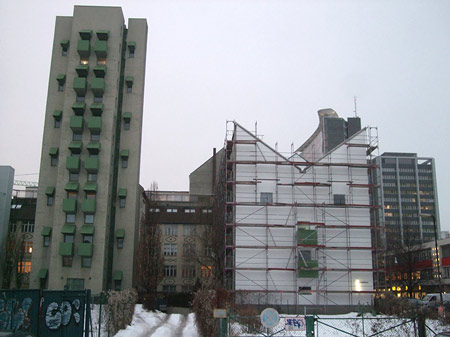
It has come to our attention that John Hejduk’s remarkable Kreuzberg Tower and Wings building (covered here by Karen Eliot in 2007) is currently undergoing a ham-fisted “renovation” job.
This afternoon Jim Hudson of Architecture in Berlin, who has covered the building in some depth as part of his ongoing IBA odyssey, forwarded me a mail sent to him by none other than Renata Hejduk, daughter of the late John Hejduk. A friend of hers in Berlin had sent her the photos shown here, noting sadly “they cut the eyebrows away”. The façade is being painted white. The original balconies and awnings are already scrap and will be replaced by new orange purple constructions.
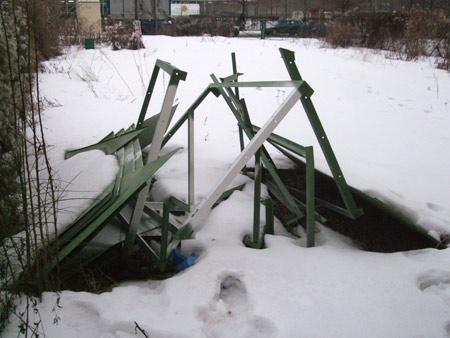
Renata Hejduk herself writes that the group of buildings are being “defaced and destroyed by a development company that bought them in foreclosure”. She added: “I tried everything I could to get them to stop and to at least consult with the Estate and other architects who were interested in helping to preserve them. They were completely uninterested and felt their facade changes would be much better than the original. Devastating.”
The development company in question is the Berlinhaus Verwaltung GmbH, of whom this journal currently knows nothing. We strongly suggest all appreciators of architecture question them on this matter, and request open dialog. Today I contacted our esteemed colleague Kolja Reichert of the Tagesspiegel about the story, as well our our friends at Baunetz. We await reply.
Can it really be that this city, which prides itself as being a culture capital, is not only happy to fill itself with the vacuous turds of property developers, but is also content to let the few genuinely interesting examples of (post/late)modern architecture that it has be disfigured in this manner by the same handful of philistines?
To paraphrase Jim, who has so elegantly put it: if you also feel that architecture has more value than just real estate, then pass on the news and get people talking.
Updates pending.
Maybe we should all pitch in and send an expensive monograph of Mr. Hejduk’s work to the head of Berlinhaus. Really, let’s do it.
Nonetheless, some perverse part of me is curious about this going on. It feels dirty inside, but some sick part of me wants to see what they do to it, and I hate myself for my stare being glued to the atrocity as it unfolds. This is kind of like torturing a cat, but I really don’t want to see it in fact get hurt. Which is what’s happening. The neighborhood cat no longer looks so drowsy, more like in shock, now. But to be perfectly clear its (only) an inanimate object and not a living thing, albeit a large one, no matter how much Mr. Hejduk imagined his object-y buildings as mythical creatures wandering through a fairytale world.
And I know its been said before, but it always seemed to me that those teeny balconies with their tiny canopies sucked from a functional perspective. Still, they were charming and in the end an important part of a seminal discourse on architecture. Yeah, there was more to those metal platforms than met the eye, even if they were better for little more than providing a place to smoke a fag for five minutes, or to act as a mount for satellite dish beaming Turkish soap operas down from Hot Bird 3 into a dark living room suffering from a real lack of direct sunlight.
Thanks for passing this on Ian, let me know if there’s any news back from your contacts.
J
I agree with O.M.’s thoughts. At what point is preserving a poorly functioning object important? Yes this was/is a significant work of architecture historically, but I would guess that the residents of the tower, or future residents, would prefer the “renovation.” I also have to point out that the building was in foreclosure as in whoever owned it before couldn’t earn money from it. It doesn’t look like hundreds of people were fighting to buy it either.
Anyway, is it sad? yes. A travesty? I’m not so sure.
O.M.: I kind of agree but what’s the functionality of a balcony in Berlin? Satellite dishes and storing ladders sounds about right. Even though I agree these flats must be dark.
I’m taking the hard line on this one. I don’t see how tearing off the balconies and replacing them with new ones in purple constitutes an “improvement†for future residences.
In terms of practical use, the building (or at least the tower), is flawed on a more fundamental level. Two years ago I had the good fortune to see one of the tower apartments from the inside. The artist who lived there had removed the door to her bedroom in order to fit a bed inside. The bedroom itself could be better described as a cell.
But that’s the point of the place. Its radicality extends to its flaws. The attempt to make the building “livable†or “practical†by junking the façade is senseless. Spinning a yarn about the location being so interesting because of its proximity to Quartier 206 and describing the flats as “comfortable†(see link below) is a pathetic attempt to tame the place. It’s an ignorant gesture intended to rob the building of its significance. Berlin can, and should do better.
There are still plenty of apartments in Berlin which are livable. Why treat a challenging piece of modern architecture as though at were just another “Palais Belle Kolleâ€? You don’t move into a Hejduk because it’s an easy-living lifestyle choice, compatible with your iPod playlist.
The problem here is the philistinism of the new owner. I don’t think people are suddenly going to move in, now that the weird “eyebrows†are gone. Hejduk’s tower needs some tender loving care (they should get rid of the cracks rather than paint over them), and a bit of clever marketing. I’m sure you could sell this to people who appreciate it is for what it is, and make more money from it, to take the point of view of a property developer.
Maybe I can convince O.M. and Lucas by pointing them to the full riot of tosh here:
http://www.berlinhaus.de/ff_new/ffws_expose.php?PHPSESSID=2d2e82a51810392d214e798da3d92808&DSN=04C3B6F0-C67A-490C-8A4D-F80A3C9E94CB
Lucas and Oliver have a point. But what I find absolutely mind-blowing is that not even a hint of a discussion has taken place. No steps have been taken to document and conserve the original. These people should at least have to explain themselves.
Maybe something can still be done …
Afraid I’m with Ian on this one. The alterations are pretty minor in structural terms, so are not going to make the building something which it isn’t, i.e. fully functioning modern apartments.
Berlin is a city that’s excelled only in blandless since the fall of the wall – so yes, perhaps it is a tragedy that the varied and experimental buildings of that immediately preceded the ‘New Prussian Stone Age’ are treated with such contempt (have just read the response from BerlinHaus to Renata Hejduk, not sure if we’re able to publish this, but it’s pretty dismissive at best). There’s almost always an inventive solution if someone cares to find this – I say this not as an archi-fan but as someone who worked adapting listed buildings in London for 15 years.
Lucas’s comment that there was little commercial interest in the building as it was is true, but I’m not sure that in itself is a justification for alteration without knowledge of or respect for the original architecture. Buildings are given Denkmal/Listed status for precisely the reason that they are no longer ‘fit for purpose’ but are worth retaining (an argument not accepted by thye current UK environment minister).
Lots for discussion at the next ’tisch!
A former resident speaks.
I lived in the 8th /9th floor of the tower for 8 years. It was extraordinary. The light is absolutely fantastic (maybe not so in the first floor of the wings,, but those flats have other qualities too, such as gardens). The plan of the tower is not your standard plan, but they were designed as artist’s studios and transferrred into social housing psot facto when the DAAD programme which they were supposed to facilitate was stopped.
It’s a plan that makes demands of you, but gives and gives and gives too. I lived there as one part of a couple, with one and then two kids, and the plan always adapted. Where else do you pay for 80 m2 and get two 36m2 rooms with light from 4 sides? This is difficult to understand from the severe exterior – but anyone who tells you these flats are dingy has just never been inside.
The fact that the previous owners went bankrupt had nothing to do with the building. I lived through their death rattles whilst there, and it was horrific. The rest of the time, they were merely dreadful.
Our Vormieters last words to me were “Join the Mieterverien – you’ll need it, and always refuse to pay the Betriebskostennachzahlung, as they will systematically try to rip you off”. Good advice. Had them in court once, and permanent trouble the rest of the time. You do not want to know the gorey details, but we were not alone. They never did anything to maintain the property at all.
The owners were a nightmare all by themselves, and managed to devalue their entire portfolio without any help from the architecture – so don’t blame the building – it only suffered from long years of neglect.
Robert,
thanks for schooling me on the interior vibe. I merely spoke from a speculative (i.e. ignorant) position. I’m now happy to know that the ensemble is really deserving of all this fuss, aside from its cultural merit as big “A” architecture.
I’m not with you guys at all on this one. This catoonish building is an embarrassment. Hejduk’s legacy was the despoilation of a generation of potential architects who were turned into quasi-intelklectual “poet-sculptors-bullshit artists” who were of no use to themselves or architecture in general.
I find it laughable that anyone takes this building seriously, or feels (in the pretentious jargon of academia), that it vwas “an important part of a seminal discourse on architecture”. Most people walking by would not give this a second glance. And who could blame them?
Let’s stop pretending this building is relevant. Hejduk was hardly a major critical thinker. He was a pretentious dabbler at best. His legacy is a few books that no one bothers to read anymore and this amateur-hour effort at design. It’s a joke.
Especially to those who respond aggressively to this project, please read the following:
The question in architecture is how do people live? Look at these windows, their natural light, it is more subtle than first glance. Anyone who lives there knows this more intimately.
What makes this project exceptional in the context of the communist housing blocks in Europe is that it is resoundingly personified and personal. The FACE on the facade and the balcony ‘features’, (places for the body) make one whole: a mutual individual and collective assemblage.
This personalization is an important historical act within the context of German GDR. And its resonance with the architectural plan is what makes this building’s Exterior an important work of architecture, because it expresses a Social Vision that is developed in the plan. (why such focus on the ‘eyebrows’). This facade is more than a cover. It has more depth than that, and should not be judged as such.
The facade is an abstraction of the Social Vision made manifest within the architectural plan: Socialism with a Human Face. <–Get it? This statement by Alexander Dubcek in the Prague Spring was a call for hope, and represented the movement and dream of autonomy, democracy and freedom, after repressive occupation. It was only 20 years later that Hejduk revisited this spirit, metaphor and dream at the cusp of the fallen Berlin wall.
This building's 'special qualities' (why it is relevant) is that it constructs a bridge between the Regime of the late 20th century, to the hope of a post-regime era. It made (and represents) a human dimension, and a humane historical progression, recalling the intangible, the memorable and the poetic. It has immense intangible value, because of when it was built and to what it called out.
If you want to complain about 'ugly' buildings, look around at all the buildings that can be separated from their surroundings and history. Buildings made just for cash. The foundation of Hejduk's project does not end in concrete, it re-energizes a spirit that for 20 years was repressed. You see, it had a social program. Ironically, however, 20 years later we have a new regime, with its own agenda.
To what extent the developer (in the free market) will reconstruct Society, we shall see . . . People live under cardboard and in glass boxes in the sky, funny looking 'balconies' are not the real problem. The easily overlooked truth is that the free market has torn down the vision of a human face for society.
This stands for Berlin as a whole, and the Kreuzberg Tower is its most explicit example.