Geology | Hardscape | Ornament

Tight and Might

/ Tue 7th May ’13

Looking out the window after a client meeting today I spied this lugubrious geological process taking place under the arcade of a 3rd-floor terrace overlooking an inner courtyard. The super-structure and interior of the building was built in the GDR and is currently undergoing dramatic and perplexing renovation: each time I visit, it is as though the corridors, rooms, flooring and ceiling and probably, yes, even the plumbing seem to have shifted ever so slightly, as though a shuffle-function had been activated in my absence. The exterior of the building is a kind of historical/pre-fab hybrid. How do you deal with geology-creep in architecture? Is ossification and calcification desirable?

Eurotrash | Holes | Interiors

Subterranean Sick Sick Blues

/ Wed 24th Apr ’13

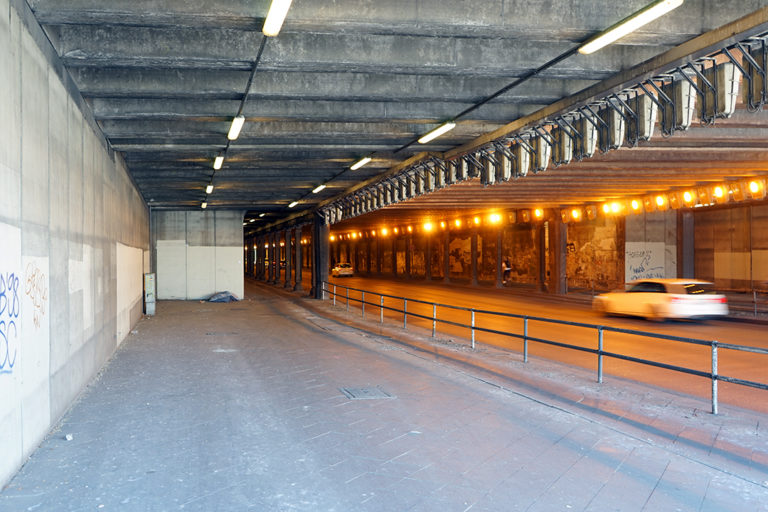
Not exactly a Florida sinkhole, but a kind of turbine or vacuum-cleaner component styled as barf-nouveau illumination. A satisfactory substitute for geology then, should your bedrock not consist of super-porous calcite/aragonite cement. It seems architecture, too, is able to dazzle with massive sudden cavities, such as here, in the bowels of Peter Behrens’ 1929 Alexanderhaus, rennovated in 1995 by Pysall-Stahrenberg & Partner (now Architekten und Ingenieure PSP).

Let us pause though, before proceeding downwards, to regard the situation flipped on its head, to see if more sense is to be made of the situation:


That business-guy silhouette from architectural renderings exists for real

Just as I suspected: the space was designed thus, and inverted for convenience. Too bad: a slow-mo shimmy across an expanse of monochrome disco-flooring is just what the bankers in the floors above could do with, come evening-time.

Peering into the sinkhole is like looking into a bowl of miso soup. It would be hard to know which one of those tofu cubes is best sat upon at this time of the morning, what with all that choice. Maybe best charge in with a feral look in your eyes and get the staff in a flurry by ordering some yard-high cream-topped latté with caramelized unguents squirted into it, then sprawl out on the sofa for two or three hours in a monosaccharide-lactose-coma, occasionally slurring something about asset-backed securities.


Where the all-day breakfast goes to retire

How did I get here? Well, routine daily trajectories have a habit of being disrupted by winter. Abandoning my bicycle for four months meant travelling to the office with Berlin’s subway system, which was good for my reading habits, but bad for my vitamin D reserves. I was desperate for daylight, regardless of how uniformly gray the sky over Berlin was, so I decided to take the bus which drives down my street, and ride it for as far it was useful. Turns out this was Alexanderplatz, where I was turfed out next to the ruinous bulk of the Alexa shopping-crypt. The subway was obviously to remain unavoidable, and so, pulled along by a vague memory, my vectors were forced back underground through Behrens’ back-door, just across the road. Which is how I ended up in this marbled cavern.

If you are used to navigating the deeper recesses of a large city via cryptic neon markings, the descent into the U8 subway-line is clearly marked. Anyone else will assume this is a tradesman’s entrance to the late 1980s: Crockett and Tubbs just called, and they want their suits back.


Follow the neon

Maybe Florida is too far afield, for I am reminded more of the 1987 Doctor Who story Paradise Towers – about a 22nd century luxury hotel complex which has fallen into an anarchic state of social and structural decay – the blue and white, fluff-encrusted neon tubes lead the pedestrian into a kind of polyurethane/marble Bernsteinzimmer, tucked away a dozen meters below street-level.

Now you’d expect a subway tunnel beneath a bank to be a utilitarian affair, but the jarring discrepancy between materials and actual use down here call the entire job into question. At the bottom of the escalators you end up in a kind of antechamber, where the neon lights and their marbled counterpart under foot end abruptly by pointing towards a pair of heavy duty blast-doors. For the pedestrian an immediate misnomer, for this is clearly not the way. The entrance to Sinkhole Café meanwhile is concealed behind a curtain of frosted glass with little or no discernable door.

The swooping super-perspective of the disco-floored ceiling sucks you through the space, as do the duodenic curves, forcing you into an accelerated trajectory towards the subway. Surfaces are of the polished, reflective variety, and with the notable exception of the marbled floor, resist focussing upon. Acoustically, the space is pretty much defined by the hurried footsteps of passers-by, only heightening the latent sensation of trespassing.

This is what designed-to-fail retail-space looks like: all that plate-glass hung from concertina-jointed door frames hint at envisaged gestures of confident mercantile display, but to what end in this armpit of a location? A catalogue of failed subterranean commercial spaces seems in order, as this is not the first of its kind in Berlin: similar lapes of judgement can can be found below Friedrichstraße and Potsdamer Platz. What does the pedestrian require in such a spot? Which market thrives in cramped burrows devoid of daylight? Speakeasies for human-sized roaches, perhaps. Or a heel and key-cutting bar with an inexplicable display of acrylic cube 3D laser portraits of your loved ones.

Crates of who-knows-what are stacked diligently behind more frosted glass, and the view through the occasional transparent pane has been carefully obscured by bin-liners. You are definitely not meant to know what is being stored here. Probably evidence of how your pension fund was vaporized by speculative-grade bond trading; reams of classified paperwork caught in a data-protection-act limbo before the subcontracted shredding company turns up.

The cheerlessness of the space is compensated for by the regular appearance of a fragmented dadarchitectural haiku, which is inadvertently hilarious. Maybe this is the delirious outpouring I alluded to a moment ago: not that of the sucrose-stoked banker in a post-latté coma, but that of a feverous architect suffering from the bends after resurfacing too suddenly from the arcane depths of the national heritage agency.

Like an assortment of non-sequiturs hung out to dry on a washing line, one reads “Glass towers” and “Gateway buildings” although none can be accounted for. At ankle-height a truncated architect’s briefing reads “Authentic reconstruction of the original”. Further down we are reminded of the “Emphasis of the supports and beams” and the “Façade of Unstrut shell-limestone”. But the denouement comes just prior to the final curve, the point at which the accumulated force of these tangential statements is honed to a quantum-dot of pure triviality in the words “Horizontal fluting of the surface”.

A confusing set of codes have congealed here, just as fats and oils clot in the sewers at similar depths. Whilst things are allowed to grow outdated, disgracefully or otherwise, this is a space which has been abandoned to a fate of material and semantic indigestion. Designed like an intestinal tract, the pedestrian is pushed through on a peristaltic wave towards the exit: a final dark bolus of steps, thick security barrier, concealed doorways, air-vents and smoke alarms which conclusively conspire to negate any intended atmosphere of lightness and effortlessness conveyed by the scattered notes of the architects.

A final surprise awaits you at the top of the steps: a glass bridge leading over the subway trains on the tracks below. To reach them, you begin a new decent, rendering the negotiated passage nothing more than a hiccup or a belch on an already disrupted subterranean trajectory.

Faux Nature | Suburbia

Douglas Kahn on Golf

/ Sun 20th Jan ’13

Click here for easier reading.KahnOnGolf

Signage

Foooooftureproof Design

/ Sun 6th Jan ’13

Pity this café in Rennes, France. They’ve gone for an interesting sign concept: large stencil font, unusual abbreviations, striking verticality, information abstracted and foregrounded. The final result is slightly complicated, but there is a spirit of simplicity that nevertheless survives. The verticalized phone number in the glass of the door picks up the vibe quite well.Come in, we're not closed.

For those who don’t speak French: the vertical column on the left indicates days of the week. Reading across, there are two opening times per day, midday and evening. ‘Open’ in indicated by ‘O’ for ouvert, while ‘closed’ is indicated by ‘F’ for fermé. Odd quasi-locutions arise if we read each line across: Luff might be a German pronouncing ‘love’, Maoo might be a Chinese dictator, Meoo a truncated cat, Jeoo a member of the tribes of Israel, Veoo sounds like a cleaning product, Saoo feels Portuguese somehow, and as for Sunday, what’s the Diff? Reading downwards also yields unintended pleasures: Fooooof, Fooooof.

But we should pity the café not for these quirks, but for the expense laid out for a fancy-pants sign which cannot be adjusted to changing circumstances. What happens if they decide to open on Mondays after all? All they can do is stick a pink sign to the glass of the door (apologies for the photography), which reads ‘Open Mondays, midday and evening’. Doh!

Aesthetics of Survival | Crisis | Earth Junk

The End is Nigh, and Available in the App-Store for immediate download

/ Fri 21st Dec ’12

What better way to celebrate today’s Mayan apocalypse than to sit down with a glass of wine and hack out my last mortal words on the theme of that post-digicalyptical nightmare which is Apple’s much lambasted Maps App?

By the way, it’s a rather delicious Greek dessert wine I’m drinking, called Mavrodafni, which translates to the suitably wretched-sounding (for the purposes of this article at least) ‘black laurel leaf’, a name which calls to mind – after a glass or two, granted – the stiffening cadaver of Julius Caesar perhaps, or the lesser known use of bay-leaves as the active ingredient of killing jars; an insecticide favoured by entomologists*.

Any way up, there’s a good two hours or so until the Mesoamerican Long Count calendar ticks over to 13.0.0.0.0, marking, according to some, the End of Absolutely Everything. Or failing that, Bed-Time.

So, about 18 Winal ago – sticking, if I may, with Mayan calendar units – I bought myself an iPad, which, since the launch of iOS6 has included the company’s own mapping App, called, ingeniously, ‘Maps’, and ousted the much superior offering from Google. In the ensuing stink which followed the launch of Maps, including the firing of iOS boss Scott Forstall in October, the much publicised cases of Australian motorists sent to outback towns which don’t exist, and a Tumblr-blog dedicated to illustrating the uselessness of the App, people seemed to forget that included in Maps is an unsurpassed aesthetic orgy of extruded digital junk, begging for some serious semantic flogging. Seriously, amidst all of the bitching about misplaced Buckinghamshire hamlets, everybody forgot how awesome one part of Maps actually is. (Reminding me, too, of stand-up comedian Louis C.K.’s rant on the Conan O’Brien show in 2009: skip to 3:20 for the good bit.)

That part can be found by flipping over to the satellite view in Maps and zooming in on one of 40 major cities, entering what Apple call ‘Flyover’ mode. Slab however are happier calling it ‘Zombie Apocalypse’ mode for reasons which will become clear in the illustrated part of this article. In Flyover, cities have been rended as 3D models using the mapping software of a Swedish company called C3 Technologies. They based their algorithms on techniques originally developed by Saab to help better guide missiles to their targets. Which is ironic, because that is precicely how Flyover world looks: as if it had been Biblically rained apon by a forty–day deluge of AGM-114 Hellfire missiles.

Flyover world is devoid of people, and rests snuggly in Uncanny Valley, that weird place just short of indiscernible perfection where the simulated becomes too weird for comfort. In it, everything looks like Fukushima: fried, poisoned, uninhabitable. This incredible technological achievement fails massively in its intention (implicitness) because it seems that the closer to perfection you get, the more exponentially small the granular resolution of reality actually is.

* It is, if you will, a deeply clausal wine, contributing undoubtedly to the large number of subordinate clauses in this article, for which the author has not the faintest intention of apologising, and which, for the most part, should be seen as been penned in the spirit, if you will, of a line widely attributed to Hemmingway: “Write drunk; edit sober”. But since there is no tomorrow …

Conspiricy Theory | Fiction | Holes

Anti-aesthetic Parcel Portal

/ Sun 18th Nov ’12

Who suspects architecture in this innocuous looking wall arrangement at Zollamt Schöneberg? The fan is anti-design, as is the ticket dispenser, the calendar, the sign, the counter, the terminals.  Yet, the situation is full of architectural meaning, certainly to you as a user, as you queue at the customs desk under the president’s watchful gaze, wondering if (metonymically) his hands will eventually appear through the tiny window and fork over your in-laws parcel, once your number is called up silently on the display, and when that might be.

With these connotations of power, and a lovely unabashed expression of direness, the arrangement even acquires a kind of dystopian bureaucratic beauty. Beautiful how this single wall accommodates in such a matter-of-fact objectivity the essential devices, services, and functions, of gate keeping, which focus an almost unnerving sense of expectation and suspense around the wall’s small and ordinary, single aperture. Will they decide favorably? Will you be able to convince them that you are not part of a transatlantic children’s shoes smuggling ring? Will you be successful in unlocking this tiny door and will you at last get to see Joachim Gauck’s hands?

An eye and an appreciation, if not a fetish, for this particular Germanic aesthetic, the unabashed, almost futurist expression of bureaucratic function, I find a sheer indispensable source of stamina in the hallways of German government buildings. I was hoping that posting two almost identical pictures of the same subject could convey a sense of the  mixture of maddening ennui and anxiety I felt being at this architecture’s mercy prior to discovering the wall’s latent beauty.

Fiction | Furniture | Nature

Grotesque, Unbelievable, Bizarre and Unprecedented

/ Mon 12th Nov ’12

In Flann O’Brien’s comic novel The Third Policeman, the scholarly philosopher de Selby examines a set of old films. He comments are that they are ‘tedious’ and that they have ‘a strong repetitive element’. But de Selby was ignorant of the nature of film projection, so he imagined that each frame would be displayed, one by one, at the speed at which he himself had examined them.

Now a combination of technological developments presents us with a different phenomenon – the urge to view gradual processes as speedy, when rendered by time-lapse photography. The coming together of cheap, programmable cameras, low-cost tripods, easy-to-use software for photographs and movies, and outlets such as Youtube has made the time-lapse sequence, once a labour-intensive, rarely-glimpsed, even auratic, genre, into one of the great banalities of Web 2.0. The predominant aesthetic has a narrow range: from corporate funky to grey-souled Silicon-Valley aetherialism.

If the most infinitesimally slow processes are routinely rendered as moving images, who has the patience for this kind of picture? Only a still image such as this can produce a sensation that is far less thrilling than wonder, but more powerful for all that. The grotesqueness of this tree consuming a bench may just be due to its torturously slow speed. The process of change cannot be blithely skimmed through. Instead, we have to be alive and be dying with the bench and the tree. This is uncanny stuff, a stabilized instability, just as in Bernini’s sculpture of Apollo and Daphne, where Daphne is in the process of being transformed into a tree.

Incorporation is a slow business. Monsieur Mangetout, a childhood hero of mine, used to eat glass and metal objects by chopping them into tiny pieces and ingesting them one by one. Among many many objects, he ate eighteen  bicycles, each one clipped down into tablet-sized pieces and washed down with an oily lubricant. I remember one TV show where they showed a moving x-ray image of his oesophagus and stomach as the parts inched tinily through his system. The pace of the process made it all the more fascinating. Fascination used to be a slow business too.

De Selby’s naivete in The Third Policeman is occasionally balanced with flashes of brilliance. He has a wonderful feel for the methodical, for the eventual, resulting in inspired theories such as that of the mollycules (=molecules). In a novel full of bicycles, this theory suggests that prolonged contact between a bicycle seat and a human backside will, through time, result in the accretion of bicycle mollycules by the cyclist. In the end, the cyclist will have become more bicycle than human. You might say it’s pathetic, poetic, non-stop, periodic, bathetic, entropic and … off-topic.

Astronomy | Signage | Speculation

Some Heavy Posthumanist Architecture Shit

/ Fri 2nd Nov ’12

I spotted a “Bologna Centrale” sign through the train window as the sleeper train from Munich coasted into the station. The sign’s squat white letters on blue seemed friendly, almost playful. It lacked entirely the staunch objectivity of fonts used in Germany in public places. It was 5 a.m.

The station’s platforms lay like illuminated piers in a calm sea of darkness.  The air felt warm and moist. The train’s arrival briefly flooded the platform with activity. By the time I entered the brightly lit main hall, emerging from the subway from beneath the tracks, the silence had returned. I stepped outside onto the station’s dimly lit square. Silhouettes of people slouched on gray polypropylene benches in polycarbonate bus sheds waiting for first buses. Strips of red LEDs glowed with dysfunct and cryptic messages. Missing LEDs created a new kind of alphabet: As that look like inverted Vs, upside down Ls, etc. The sole source of activity were the flashing lights of the pedestrian crossings.

It would be a while before the first buses would run. So I photographed a decrepit area map with my phone and headed up Via Independenzia towards the city center. I had walked under the city’s famed arcades for about half a mile when the street lights went off, leaving me stumped in near complete, pre-industrialized vampire darkness, a good half hour before early dawn. Was this an austerity measure in light of the European debt crisis? The darkness drove me out into the faint light of the street, where with some effort I could still make out the black outline of buildings and some of their figurines and crenelations against a indigo black sky. Farther up Independenzia, flat white bands of a zebra crossing led like stepping stones across a bottomless darkness straight into San Pietro’s main portico. In comparison with the depth of the church’s baroque facade, the strips had an almost Julian Opie like flatness.

For a while, I wandered the dark alleys and arcades around Bologna’s Piazza Maggiore central square trying to find my hotel. I hadn’t slept enough and there still wasn’t a whole lot of light in the city’s medieval alleys. First encounters with other humans seemed almost hallucinatory. Two street sweepers in perforated green and white plastic vests swept the streets to the beeping sound of a tiny light-gray Piaggio three wheel pick-up in reverse. I zoned out briefly on the hypnotic reflections of the Piaggio’s orange flashing lights on their vests’ reflective 3M strips. The polyurethane wheels on my cheap-ass Samsonite trolley echoed hollow and mute on empty paved streets.

As I left the beeping street cleaners behind, golden axonometric capitals of a beautifully painted sign popped forward out of the residual darkness under a heavy masonry arch: OTTICA A. PAOLETTI. The lettering was squarish, thin and elegant. A perfectly executed gradient on the letters’ extruded sides created a convincing illusion of depth. I stared at the sign for a prolonged time. Residual darkness acted as a filter, illiminating the imperfections my eyes cling to to accept things as real. It appeared almost immaterial, even metaphysical, pure letter, pure signifier.  I would shop for optics in a shop whose owner has such a good eye, picking signage that denoted optical precision by standing up to the most scrutinizing visual inspection, to the most exacting optical equipment. During my last examination, my eye doctor had attested to my eyes’ extraordinary resolution, despite my short-sightedness. I was on a Via Clavature, in a cluster of opticians and optics shops very close to Piazza Maggiore. Ottica Paoletti sold premium optics - mostly analog camera equipment, binoculars, sunglasses. I recognized the brushed aluminum of a Nikon FM2 and recalled the swooshing sound of its smooth shutter mechanism. I checked the map on my phone. My hotel on Via Drapperie was just around the corner. As I set off, I felt an anticipation for Bologna and what it would have in store for me. I wondered what effect the city’s physiognomy may have had on Umberto Eco, now professor emeritus of semiotics at the University of Bologna.

I woke up in my hotel room close to noon. Intense sunlight filtered through the gaps of the heavy velvet curtains. I reached for my phone and searched for a quick Bologna primer online. Mentioned there was a pinhole optical device in the roof of the eastern aisle of the city’s main church, San Petronio, on Piazza Maggiore, just around the corner from the hotel. As a camera obscura, it focused the inverted image of the sun every day at noon onto the world’s longest meridian on the church’s floor. After a quick coffee and pastry on Via Drapperie, I passed Ottica Paoletti again on the way to the cathedral. Under the sign’s crisp lettering, a studious looking middle-aged woman in pale green cardigan arranged a few camera accessories in the shop window glancing over reading glasses with transparent plastic frames. The shop’s interior brimmed with activity.

A printed banner depicting the intended white marble finish covered the bottom half of San Petronio’s crude and derelict brick facade. Inside, I spotted the meridian pretty quick, a thin 60m diagonal brass line set in white Carrara against the red marble of the church floor, starting in the western aisle and traversing a line of heavy piers into the church’s soaring nave between piers 2 and 3. An oblong depiction of the sun surrounded a rather small spot of intense light in the ceiling of the eastern aisle’s fourth vault, just above the meridian’s origin. Zigzagging golden rays emanated outward from the glaring speck of light at its center. I had to search a little for the sun’s image and found it a dozen meters west of the meridian. It was around 11 a.m. The light spot was somewhat oblong, skewed by the light’s angle, recalling the oblong depiction on the ceiling. Its halogen blue halo flickered a little and it cast shadows of unnatural sharpness. This kind of sharpness I only knew from the light of projectors. I experienced a similar kind of visual dematerialization, in light of perfection, that I had witnessed in the hand painted sign of Ottica Paoletti, or when looking at a holograph.

It took my pupils a minute to re-adjust to the relative darkness of the church’s interior and until the image of the reflected sun that had burned itself on my retinae had waned. I was now on a Fantastic Voyage. The church had become the eye of a giant sentient being. The church floor was its retina, onto which images of the outside were projected through a tiny cornea in the church’s ceiling. The sentient being was the giant arthropod of the Vatican Church, and San Petronio a ommatidium of its compound, knowledge seeking, eye, scanning dark ages for enlightenment.

I spent the next hour trying to decipher the information on markings along the brass meridian, making out summer and winter solstices, vernal and autumnal equinoxes, and the zodiac signs. I couldn’t make sense of a row of numbers from 1 to 250 and roman numerals from XV to ??. At noon, I stopped my interpretations, transfixed with excitement on the sun’s image as it crossed the meridian. Then a guard in double breasted jacket emerged from the shadows and advanced toward us. He wore his jacket sloppy, as if he had thrown it on quickly. What could he want? Were they really ushering us towards the exits right as the moment of magic that everyone had been waiting for? As cosmic as this event was to us visitors, to the guards, it was as profane as the beginning of their lunch hour. For a moment, I was startled at the thought that generations of church guards over hundreds of years had had their daily rhythm defined by the meridian, briefly sharing this cosmic moment with flows of visitors only to shatter it, asking them to leave so they could take their lunch break. To them, the meridian was nothing more than a giant punch clock.

Perplexed by my sudden ejection, Bologna’s colonnades seemed like mere extensions of the San Petronio’s aisles. It made me think what aesthetic impact such a magnificent structure, essentially a inhabitable astronomical instrument, might have on its surroundings. First, on people’s aesthetic perceptions and then on the architecture they would go on to create in the church’s shadows based on these perceptions. San Petronio’s meridian must have spawned the interest in optics and the optics shops on Via Clavature. What light could the curtains of Via Drapperie have concealed? Azimut investments occupy offices on the second floor of a building just across Piazza Maggiore. Across Via Rizzoli, we found another cluster of shops selling globes in various sizes and materials. The sunlight hit the globes at an angle beautifully, in a way that invoked azimuths and apogees and perigees, again. Bar Sol sells wine in one of the alleys around the piazza.

http://www.imcce.fr/hosted_sites/meridienne/italie.php?lang=en

Had we found a trace of the influence of the city’s architecture on the author of Foucault’s Pendulum? Was its early working title Cassini’s Meridian? The clerical secrecy in the Name of the Rose seemed to recall the Copernican discoveries that resulted from San Petronio’s meridians, initially commissioned by the Vatican for the eventual reformation of the Julian calendar, to facilitate the prediction of Easter, and kept secret during the trials of Galileo.

It’s the beauty and perhaps the tragedy that the influence of things, architectural and otherwise, seems to operate more often than not on a subliminal, unforeseen level, beyond our control as architects or authors, no longer architects of our own vision, but unknowing obsequious servants of bigger ideas silently at work outside of us, the workings of post-humanist architectures.