Periptero
Note: this article was originally published in May 2009. In April 2017 it was re-edited: the closing remarks have been completely re-written, and it has been factually updated to reflect some of the more recent (and typically dismal) political and economic developments in Greece.
Whilst in Athens recently I developed a small obsession with the tiny, ubiquitous kiosks known as periptero, which are to be found on just about any street you care to mention. The name is related to “peripteros”, which is the name given to Greek or Roman temples which are surrounded by a portico with columns. These tiny commercial units have an institutional status in Greece: they serve an important socio-political role through the regulated way in which kiosk licences are awarded to applicants by prefectures, and they do much to define the spatial and civil character of urban areas.
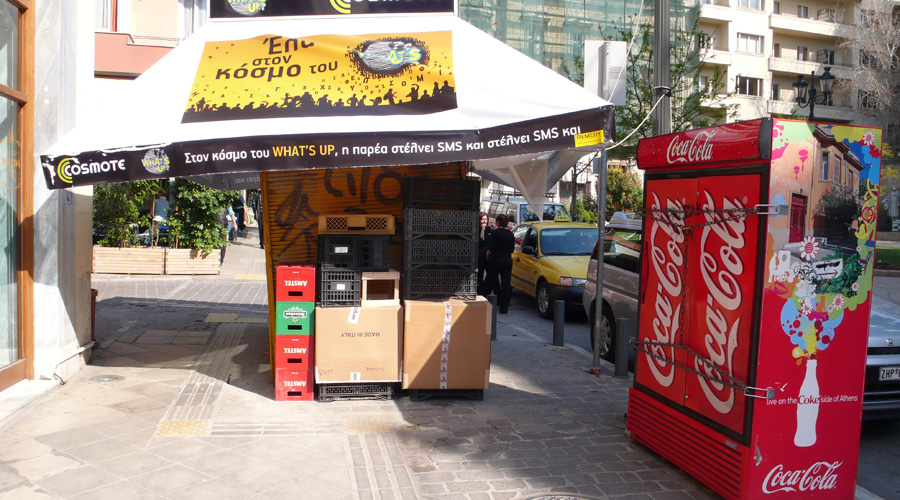
A periptero on Mitropoleos in downtown Athens.
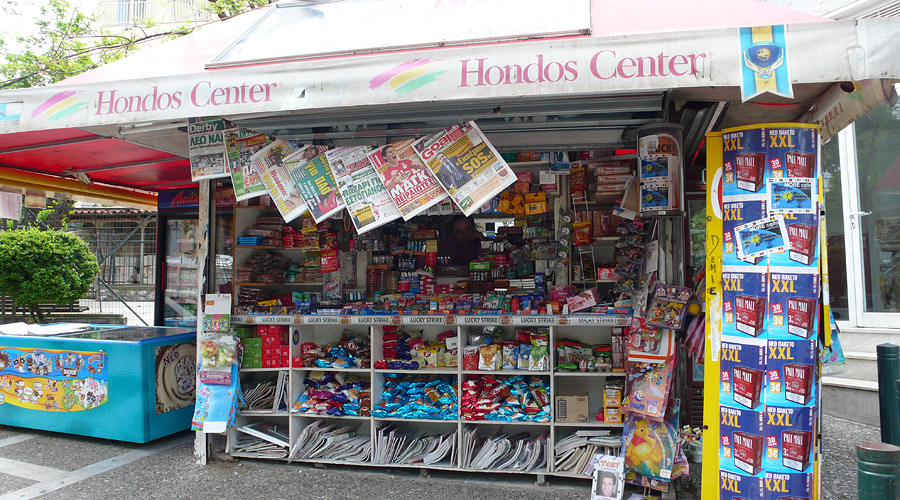
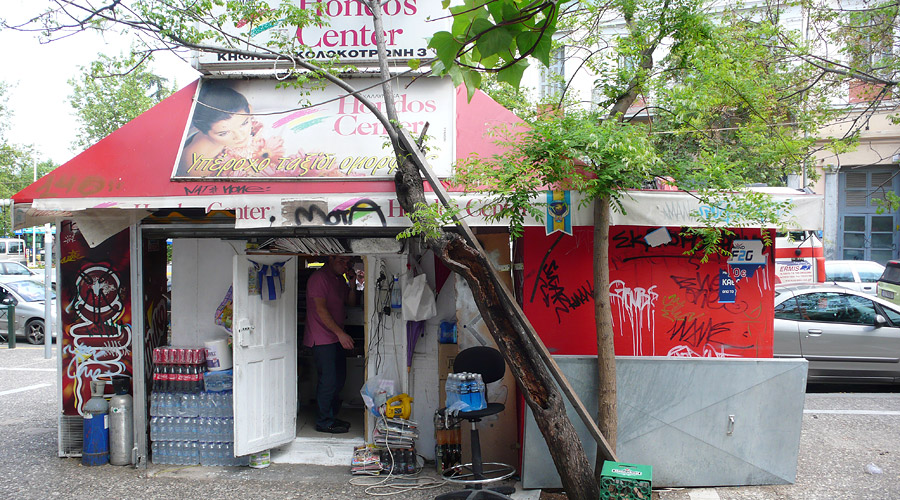
One of three periptero on Kassaveti Street in Kifisia.
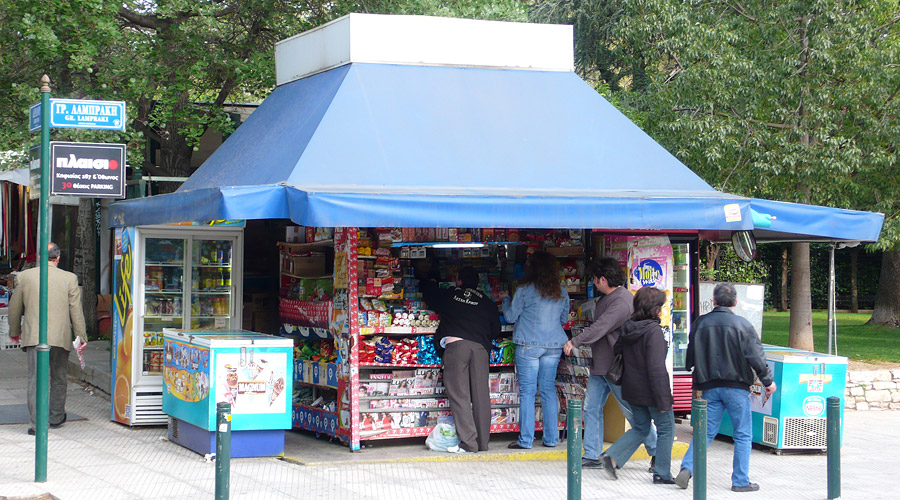
On Grigoriou Lampraki, in Kifisia. A mirror has been installed under the awning, as a precaution against theft. Some periptero are equipped with cheap, off-the-shelf CCTV cameras.
The economic importance of periptero for their owners is self-evident, but cannot be understated for the country as a whole. In 2005, Greece’s estimated 18,000 periptero had an annual combined turnover of 7 billion Euros, a sum which made up 5% of Greece’s GDP [1]. Since the economic crisis, the number of kiosks has dropped to 12,000 and a bill announced in 2015 includes a provision which will prohibit the renewal or transfer of licenses after an owner dies or a kiosk closes.
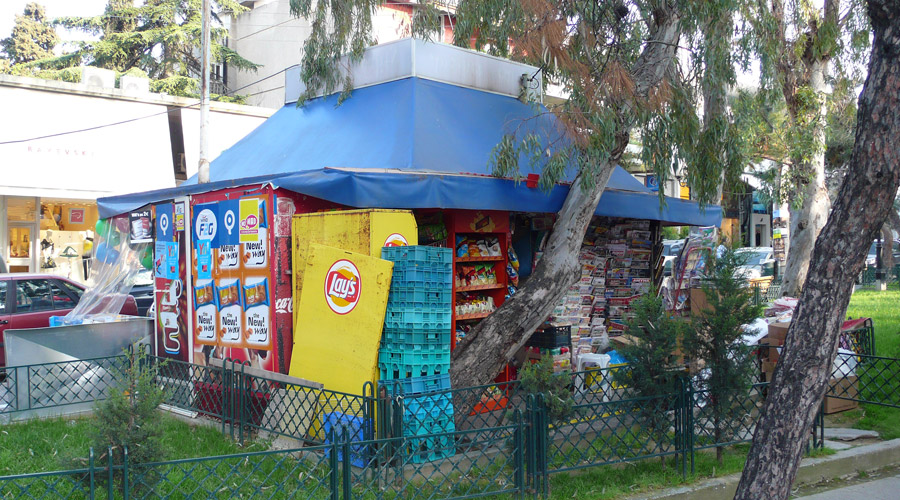
Squashed between Agiou Dimitriou and Kyriazi, again in Kifisia. The rear space is further defined by the fence, and is half ‘shop floor’, half storage area.
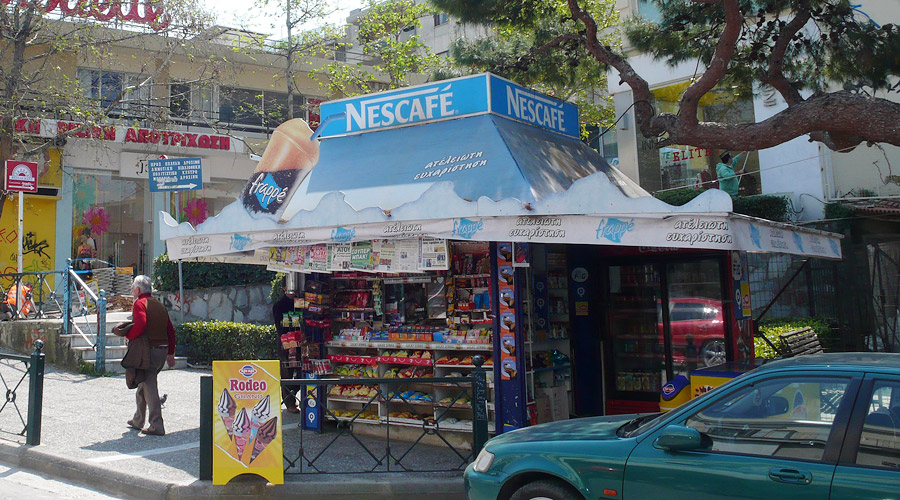
The frappé-foam-roof periptero on Kassaveti Street.
Almost all periptero have the same statutory floor-plan of 1.3 x 1.5 meters. This can best be seen in the first photos at the top, where the basic shell is quite apparent. Wooden shelves usually surround the core structure on three sides, with magazines and newspapers typically displayed to the left and right, but sometimes also lower down at the front. Chewing gum, sweets, chocolate bars, crisps, and smoking paraphernalia can be found directly around the sales-hatch, as can disposable cameras and batteries. Transactions take place through a hatch no larger than an unfolded newspaper, and access is provided by a door often orientated towards the curb. The door is one feature which differs wildly, as though particularly prone to replacement: one door I witnessed was little more than a tin flap, whilst another was a typical, mass-produced front door more typical to a single-family home, though sawn off to a height of a little more than a meter.
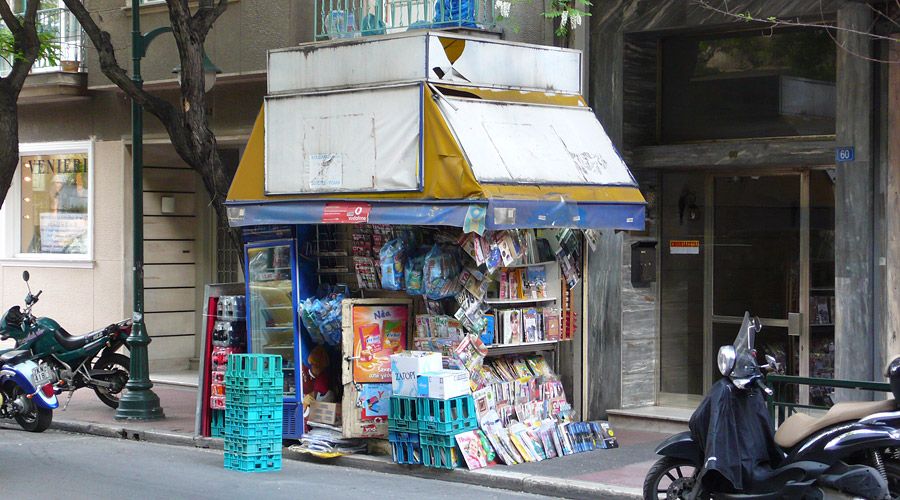
A modest periptero in the decidedly ostentatious Kolonaki district of Athens.
Whilst the floor-plan is regulated, it is the space directly below the canvas roof, surrounding the central structure, which makes the periptero such a fluid piece of vernacular architecture. Judging by observation alone, it appears that the pavement space which may be utilised by the kiosk should not exceed an area defined by the perimeter of the canvas awning. The extent of the awning, however – whilst providing shelter from the elements, and defining a border between the exterior public sphere and the interior private sphere – seems bound by no obvious legislation.
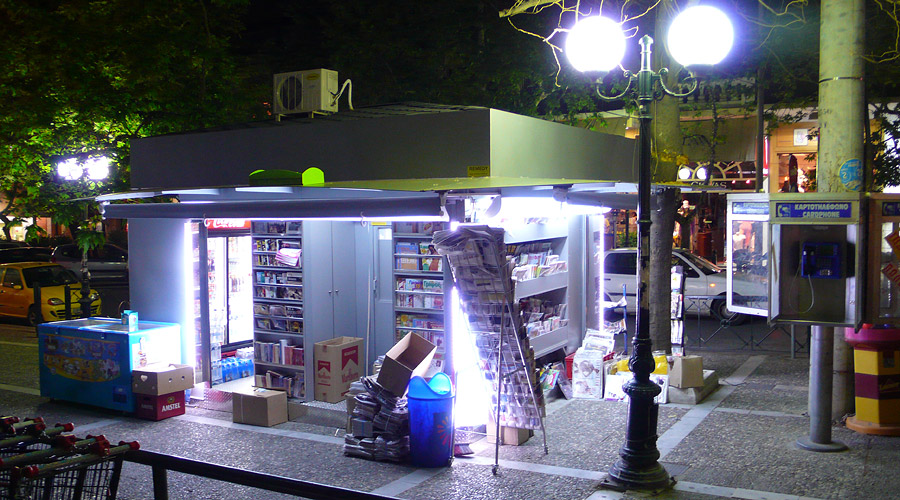
In the example above, fridges function as an exterior wall, thereby creating an interstitial corridor. It is also mounted on an aluminium plinth, elevating it from the street. These two features modulate the typical periptero-typology, creating a hybrid more akin to orthodox architectural forms with a rigid outer shell. The tree growing through its awning, though, is a reminder of the periptero’s enduring, and characteristic accommodation of the exterior.
Periptero are the architectural manifestations of a grey-area between the municipal, normed and pre-fabricated, and the personal, unregulated and modifiable. They are a pure form of retail-architecture, with the mechanics of storage and trade defining the fabric of the built structure, rather than hiding it behind the veneer of the spectacle. Their ubiquity and visibility, combined with the interventionist strategies undertaken by their owners, make them a unique vehicle for the expression and interpretation of economic narratives. Kiosk owners forge close relationships with their customers, and become vital points of social interaction for informal exchanges of gossip, opinion, local history or just the comfort provided by the regular greeting of a familiar face. Should the periptero vanish from the streets of Greece, more will be lost than just a place to buy the paper and some cigarettes.
[1] Το Βήμα, 2.10.2005