Archive for the ‘Hyperreal’ Category

Dig me up, Scottie

Monday, September 5th, 2011

black monolith 2

Sorry, I can’t hear you, in my Motel-One turquoise “viel Geld für wenig Design” (plenty-design-for-little-money) Arne Jacobsen Egg chair, I’ve got a Caterpillar in my ear. How can this man slouched on the modernist sofa in the hotel’s loggia be so calm among the construction mess that surrounds him?

egg chair man

smart phone guy

I guess because he’s really not here. He’s cyborged himself into his smart phone and has found placid serenity somewhere else cyber. Something distant has temporarily gotten hold of his brain through his eye sockets. Maybe he’s near the nadir of a tanked investment that has just crashed through the 50 day moving average, or in a candle stick graph of his short sell that’s just brushed a Bollinger band, and he’s already booking a room at the Mandala, or he’s checking Zalando for the latest model of Geox shoes he has a knack for? Who knows? But he certainly doesn’t seem to be here.

These are some really interesting thoughts. I appreciate the opportunity of having them every day. Commutes in Berlin change almost daily depending on the circulation requirements of the many construction sites that dot one’s way to work. The last few months things have really crescendoed to new levels on my commute, around the future junction of Leipziger Straße and Axel-Springer-Straße that is nearing completion. This connection was severed by the Wall. Soon, it will direct four lane traffic right past my studio window towards the A111. The adjacent Motel One was finished earlier this high season, touting viel Design für wenig Geld (plenty design for little money) to Berlin’s many visitors. “But why in German?”, I ask “who speaks German that stays here?” and now I feel this has got to be deliberate, this taunting on my way to work, reminding me of all the design I offer for little money.

vdfwg

As the finishing touches are put to the new intersection, I get shepherded around Motel One in constantly changing ways. I am led through makeshift channels of galvanized steel mesh that cut fresh twists and turns through heaps of rubble and virgin construction sands like CNC tool paths. Different facets of Motel One’s rich value designs reveal themselves to me every day, brushing up against different factory fresh surfaces, pieces of furniture, or topiaries. I come comically close to people in designer furniture, closer than ever intended, spot new superimpositions of myriad reflections, or almost run into an old lady and dog or get hit by a cyclist on the loggia, lost for a passage around Motel One. It feels like universes colliding on a smaller, more mundane scale. Pedestrians seem like machines whose algorithms cannot cope with a new, unexpected topography. With each new choreography and disparate encounters, each new vista, Motel One seems to acquire some mysterious dimension. Did I just spot Yul Brynner, are those cables sticking out of this man’s chest?

way round m1

no way thru

building intro

eternal shade

The courtyard reminds me of New York, somehow. Below, there’s a green amenity space of manicured lawns and wood chip covered terraces. Beach recliners in Motel One turquoise and brown look forlorn amidst all the construction paraphernalia and soaring GDR era high rises, look like creatures themselves. Occasional guests in slacks and other business casual slurp Cosmos or wash down Alfons Schuhbeck sandwiches with a wheat beer, on timber decking stained in mahogany. Brand is everywhere. Retracted linen parasols carry a promise of intense sunlight; an empty promise, given the eternal shadow cast by the adjacent GDR high rise. Unless there is foreboding in these parasols? The whole thing feels like it came out of nowhere, plopped down and teleported from a parallel reality, where it left a gaping absence, as alien as the presence it has created, here, and tearing some people out of context along with it. Through kaleidoscopic glass, I see projections of films that show this place in the twenties and thirties, topical mementos excavated by all this digging. On one of my daily recurrences around Motel One, it feels as if it has solidified or cured into a monolith of pure carbon. I suddenly think of the Ka’ba and Mecca, of tourism and pilgrimage and meditative recurrence, the infinite verticality of meteorites and of sacred spaces that can only be attained in mind and not in body, and all the things sinister and divine that happen behind the dark, silent reflections on its Low-E glass.

black monolith

New Death Strip Prequel Part 3: Floating Further out into the Cultural Vacuum

Monday, January 17th, 2011

Here we present the last of three installments of Oliver Miller’s rejected text intended for our upcoming print publication, The New Death Strip. To read the previous sections, and to find out more about this, our most exhaustive project to date, please read the preceding entries from January 8th and 15th, 2011. The New Death Strip is at the printer now and should be available both in hard copy and online by the end of the week.

-Ed.

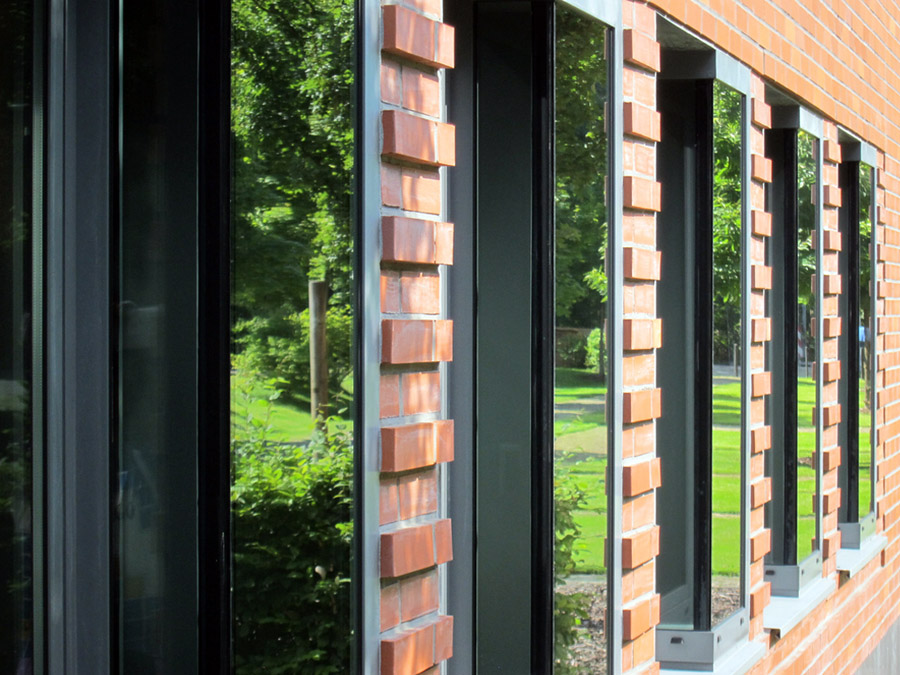
The edifice was virtually dissolving before me as I became entranced in these spectral reflections, and looking back down at the rest of the campus’s landscaping and architecture it all appeared less solid than before.

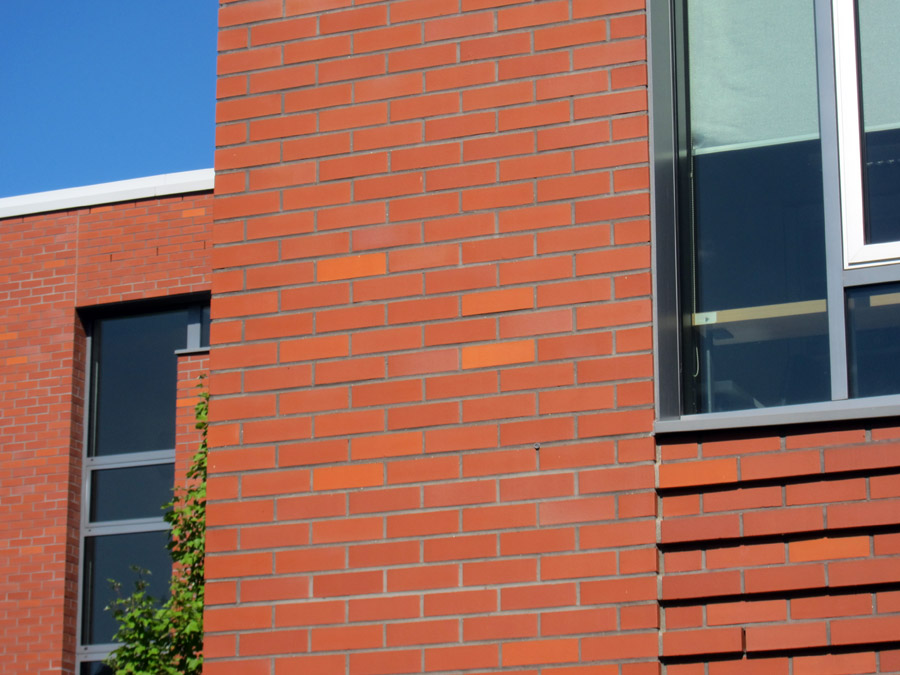
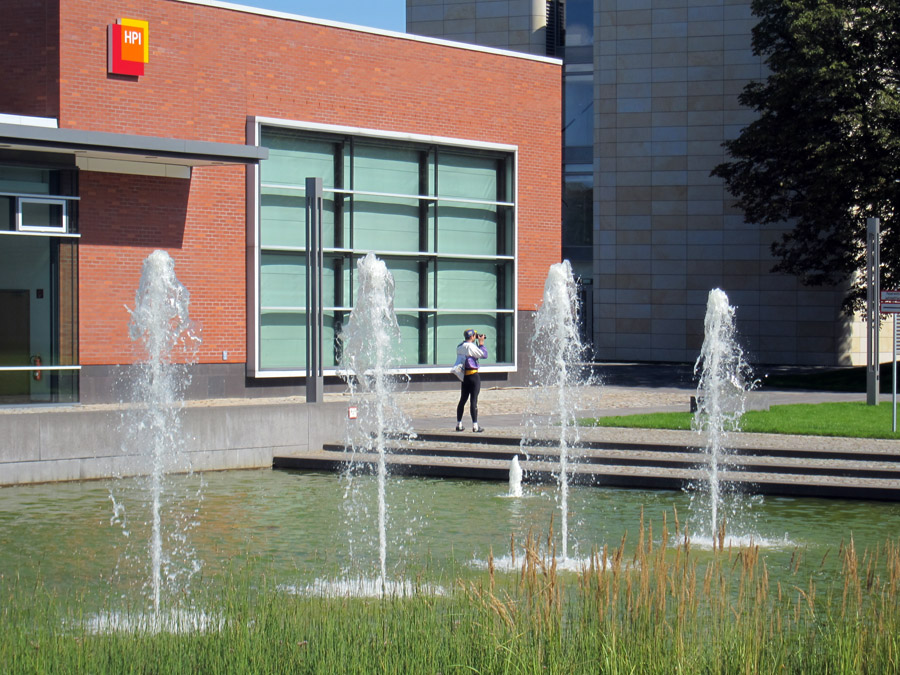
The grass struck me as uncannily thick, vibrant and uniform in color and density, the brick cladding of the other buildings at the institute had the familiar look of the scanned texture map I’d noticed back on Brunnenstrasse. Preposterous fountains spurted upwards from greenish ponds that appeared unimaginably shallow.

Everything looked clean and new and in a certain sense no less reflective than the polished glass of the new building’s curtain walls. In a world of Photoshop effects, smoothing filters, color balancing and corrected saturation, it seems there’s an irresistable drive to create a world in the image of the image.

A there-but-not-there feeling overcame me, and I spent the next hour or so wandering more or less aimlessly around Hasso Plattner Institute. The pristine artificiality of the place, its sheer made-up-ness, had put me into a space of existential contemplation. I had quite simply ceased to feel like I was anywhere anymore.

People use the metaphor of a desert to describe a place -or a state- in which you feel empty or placeless, but my childhood in New Mexico gave me a sense for the richness of life to be found there. At HPI I felt a truer form of emptiness, and now I wonder why I became so transfixed by the polished reflections of the new learning and research center. They seemed to have a cathartic effect, somehow canceling the irritation I’d felt from sustained exposure to high levels of bogusness traversing the vicissitudes of The New Death Strip . To just look away entirely, straight into the sky or towards the rail line or a group of trees outside the campus’s border, seemed like the denial of something. But by gazing into the reflections I could somehow look at the architecture without flinching. I found a way to suspend judgment on an architecture that I’d initially found to be plainly deterrent, and the act seemed to have implications for the rest of my survey in general. The NDS can be seen as a panoply of disassociated visions, each one highly specific in the minds of those who were responsible for turning them into something more real. Because it exists in a space lacking cultural legacy, anything seems possible on the NDS. But for whatever reason, whether economic, sociological, historic or psychological, there’s not much along the line of the old Wall that’s exuberant or experimental. It may just be down to the fact that it’s much easier to have a vision than to be visionary. The entire ensemble at HPI, and along the New Death Strip as a whole, is a mirage. It is the production of so many irregular conditions that float within a cultural vacuum, a cross section of refracted and disassociated allusions to the culture of its makers. Only by accident, it seems, has something taken seed there that can be seen to be legitimately either conservative or radical.

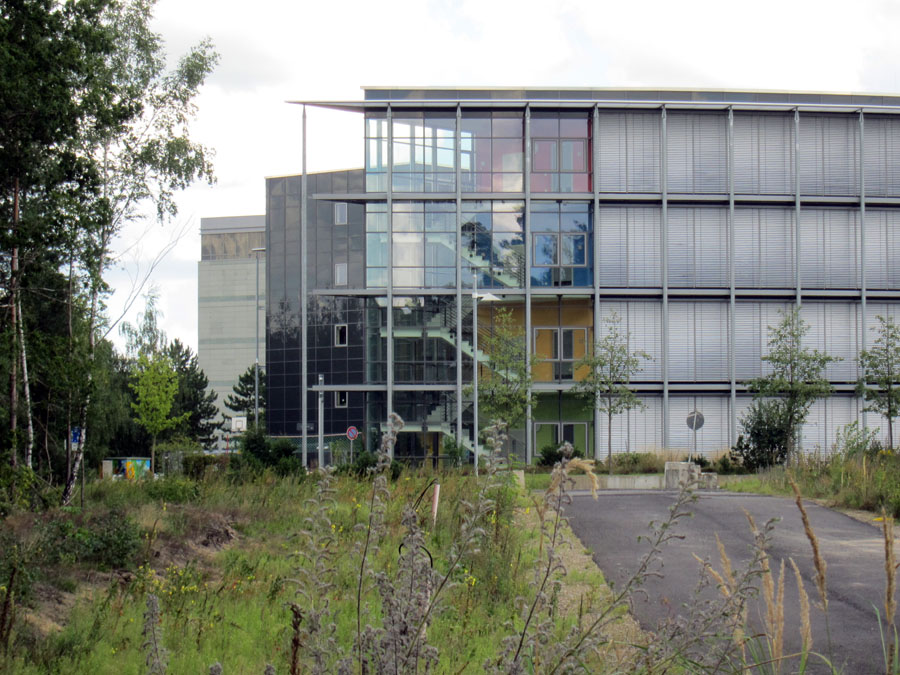
After the time spent at HPI the mirage feeling kept recurring. Following a much needed bucolic romp along the Stichkanal we came upon Europarc Dreilinden, a towering island of commercial real estate speculation built upon the former site of the largest border crossing between the old East and West, the place that was formerly Checkpoint Charlie’s lesser-known big brother, Bravo. Navigating our racing bikes over the bumpy terrain of the footpaths to its north, the back end of the some multinational HQ rose from the sandy forest like a volcano of capital from Brandenburg’s economic wastelands. It was totally covered in glass curtain walls, some shuttered a la HPI, and I immediately began trancing out on more of those puffy clouds being mirrored back to me. For a moment I looked deeper, behind the reflections, and was able to identify the building’s occupant without the need for any signage or cute logos.

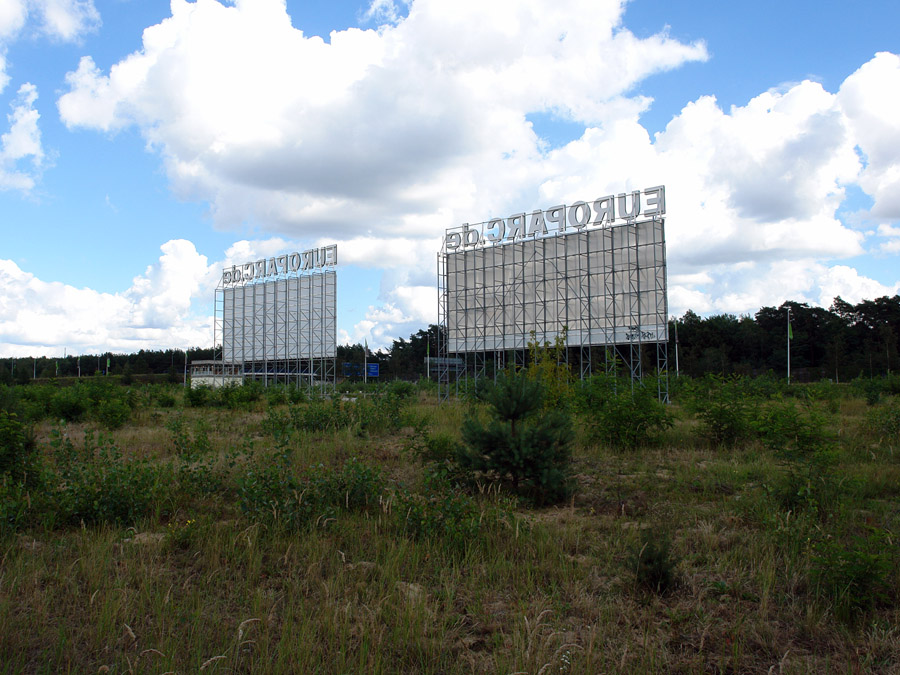
The walls of the hallways had been color coded floor for floor in Ebay’s signature palette of red, blue, yellow and lime green. Beyond, two more office blocks gently imposed themselves upon the scene. The first was clad with polished black glass, the second in perfectly planed limestone tiling. If HPI were a talented pup showing industry and promise as it explores the new surroundings of its Prussian socio-cultural landscape, Europarc would be a hyperreal alpha male wolf, lurking silently but ready to pounce. The expanses of smooth façades drew my eye from one consummately ludicrous high rise to the next, until the biotope landscaping feature at the center of it all tempted me to supplant reveries born of glass and steel with the picturesque vision of their own reflections in the watery stillness of an artificial wetlands preserve. To the south, beyond the reeds and willows of the landscape feature, I saw the backwards letters of the two great “EUROPARC.de” billboards. They stood side by side above naturalistic ground cover, like twinned sentinels protecting this corporate fantasy from the forbidding threat of the A115 highway beyond.

I turned back and after a little while happened upon a cozy loop road doing its best to link up the motley cast of architectural characters that make up Europarc Dreilinden, each one the fragment of a collective dream that offers no rest. Amongst the such neighbors as the Porsche dealer, Ebay+Paypal and the Ibis hotel there stood a pristine, new, and un-demarcated building. Like the learning and research center at HPI, it was so fresh that it hadn’t been finished yet. Refuse from its construction littered the edges of a freshly asphalted parking lot, and the place felt calm as I continued to document the paths of clouds reflected in the structure’s expanses of glass.

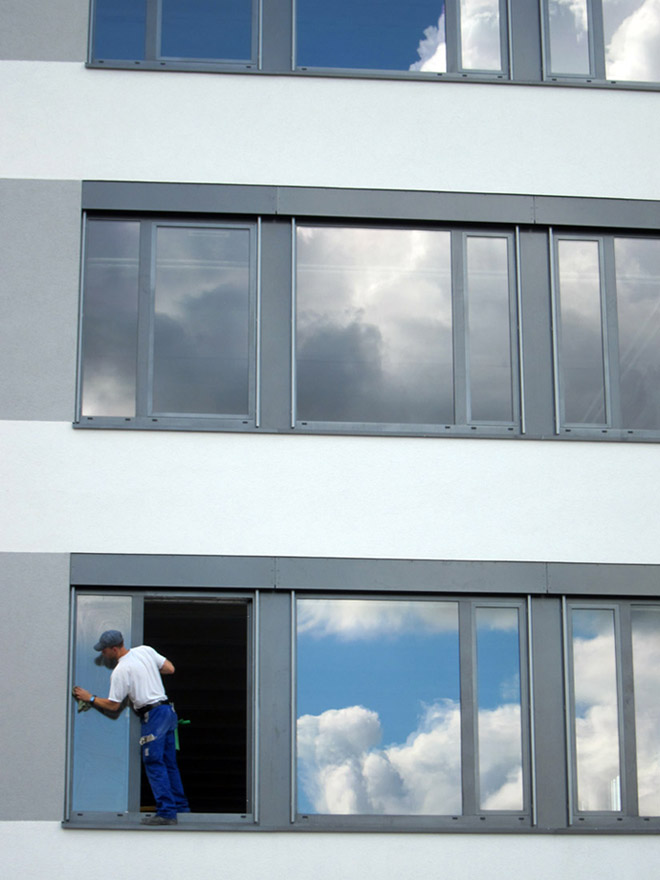
Only a lone a window cleaner interrupted my meditations as he carefully wiped their panes clean; the mirage, I then understood, has to be diligently maintained.

This is Who I Want to be Cremated by When I Die

Wednesday, April 14th, 2010

For years I’ve smirked at this trippy-dippy storefront on colorful Torstrasse, and a few weeks ago I finally picked up a new digital camera that’s capable of capturing it in (almost) all of its nighttime glory. It must be familiar to many fellow Berlin residents, but I feel compelled to share these images to our readers out in the wider world.

Asgardbestattungen1_lores
Eurotrash burial, on the cheap.

In this case I have to wonder if having fun as a window dresser could be costing a business valuable customers. You never know in the east side of Berlin. Is the responsible party in fact winning their business with this unlikely scenography? Or perhaps the people who enroll the services of this undertaker are just oblivious to it all, and are simply taken in by the assurance that the work will be done on the cheap.

Birds of prey that hunt by night make me feel more comfortable about death
Life Death under blue light.

The artistry demonstrated here does nevertheless provide a brave response to the quandary as to how in the name of the lord an undertaker should decorate a shop window. What dreams of death were occupying her subconscious while she hung these curtains of mirror mail? To be sure: as far as purely affective power and the ability to provoke the viewer goes, this work trumps anything you’re likely to see in the trendy art galleries to be found in the same neighborhood.

Next up: Berlin hairdressers’ trashy storefronts. Send us your pics!

Warning: Lethal, Gurgling Simulacra

Sunday, January 17th, 2010

gurgling simulacra

“For your own safety, no wading or swimming”.

That’s what the warning sign says. Proof that fiction can kill you. If trans fat doesn’t get to you first. Or your satanic neighbor. In hindsight, I wish I had taken many more pictures during my three week sojourn in the burbs of California. It’s hard to pick out whats significant if you are totally immersed in a seamless landscape of illusion stitched together by things like this.  By “Things like this” I mean higher degree simulations, copies of copies that have no traceable origin in something that is not an image. Only, but welcome, reminders of an alternate reality were a few black hawks and a flock of turkey vulchers that had convened on a housing association’s club house. For me, there is a fundamental difference between something like this and, for example, immigrated Welsh farmers of Bruce Chatwin’s Patagonia making themselves at home by the continued use of the Welsh vernacular, or their neighboring German immigrants doing the same by planting cherry trees.

Oh yeah, and those stairs really don’t lead anywhere ”¦

I shudder to think my existence could end then and there in the foot deep rippling reflection of Hadrian’s petrified mirage of the Spanish Steps ”¦

alpine cascades

”¦ uh, I crave a spumante ”¦

simulacra2

Any ideas for alternate inscriptions?

Ye Olde “The Plane & Pub” Pop-up Pub

Monday, November 30th, 2009

Here you can see flight EZ4531 to Madrid walking through the Dog & Partdridge at SXF, with a delay of about 15min.

instant pub 01

I always look forward a little to this strange surrealist juxtapostion, by mytonomie, of plane through pub. Both, passengers and pub, seem to have lost their hull (Hull?). It reminds me of the jet engine crushing through a suburban home in Donnie Darko. There’s got to be a space-time portal in here somewhere leading to the beginning of a mind blowing narrative.

Check out the Tudor detailing and the micron-thin carpet, crisply bisected by the terminal flooring. Is it to assure that the cleaning contractor can clean right through, for insurance purposes, or because they haven’t come up with a carpet that can withstand the steps of 6.6 mio annual passengers that pass through this pub a year? That’s got to be a record, and talk about Laufkundschaft.

Virtual Lego Shed

Sunday, March 29th, 2009

Using Lego’s Digital Designer Software, I have built a shed. Joy is a real shed; faint amusement is a virtual shed; and unadulturated eccentricity is a virtual Lego shed. It’s an unconventional way to spend your time, but when you get into the groove of deep, left-field architectural research, you just have to ride it out and see where you end up.

Building with virtual Lego is a trade-off between the complete lack of tactile fun, and a limitless supply of bricks. It’s like Google’s SketchUp, except that when you’re done, you can click the ‘Order’ button and have your shed shipped out to you at enormous cost.

These are great times.